- EPA rating: 40 MPG combined (Hybrid)
- Real-world highway: ~33.3 MPG (Edmunds tested)
- Hybrid range up to ~560 miles per tank
- Gas CR-V range around 400–450 miles
- Range varies by driving style, AWD and conditions
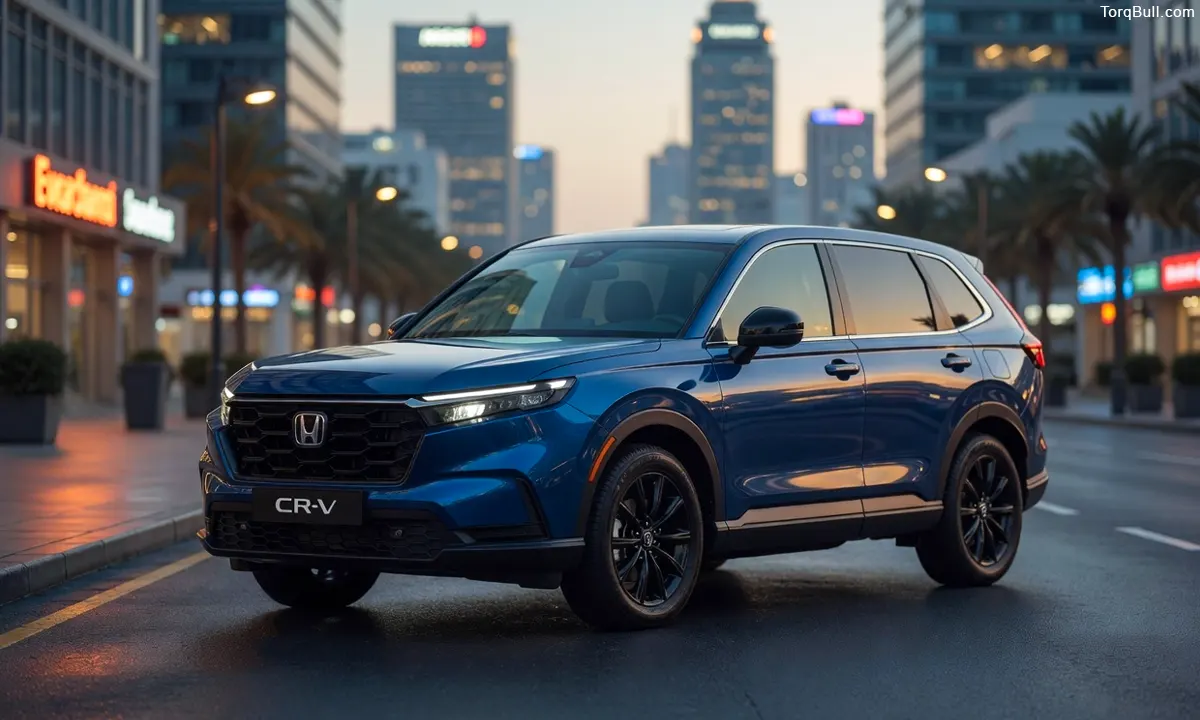
Honda CR-V Real World Range: The EPA fuel economy rating on a window sticker gives buyers a standardised reference point for comparing vehicles, but it almost never tells the complete story of what a vehicle will actually achieve in the conditions where its owner will actually drive it. The Honda CR-V’s EPA ratings are among the most competitive in the compact SUV segment — 30 MPG combined for the standard gas model and 40 MPG combined for the front-wheel-drive hybrid. Whether those numbers translate to real-world driving across American roads, in varied traffic conditions, at realistic highway speeds and in weather that ranges from summer heat to winter cold is the question that matters most to buyers making a purchase decision. This guide answers that question with data from automotive publication testing, owner community reporting across tens of thousands of real tanks, and the specific factors that push any CR-V above or below its EPA estimate.
The 2026 Honda CR-V: Every Powertrain Configuration and EPA Rating
The 2026 Honda CR-V is available in two distinct powertrain configurations, each with front-wheel drive and all-wheel drive variants, producing four separate EPA rating points that form the baseline for any real-world range analysis.
The standard 2026 CR-V is powered by a 190-horsepower, 1.5-litre turbocharged four-cylinder engine paired with a continuously variable transmission. With front-wheel drive, the EPA rates this configuration at 28 city, 33 highway and 30 MPG combined. The all-wheel-drive version returns 27 city, 31 highway and 29 MPG combined — a difference of one city and two highway MPG that reflects the additional mechanical friction of the rear drivetrain components.
The 2026 CR-V Hybrid uses a naturally aspirated 2.0-litre four-cylinder engine paired with two electric motors for a total system output of 204 horsepower and 247 pound-feet of torque. There is no traditional transmission — the electric motors function as a continuously variable ratio system. With front-wheel drive, the hybrid is EPA-rated at 43 city, 36 highway and 40 MPG combined. With all-wheel drive, the ratings are 40 city, 34 highway and 37 MPG combined. The hybrid’s city rating advantage over its highway rating is significant and deliberate — it reflects the hybrid system’s core advantage of regenerative braking and electric-only low-speed operation, which recovers energy in city driving that conventional gasoline engines waste entirely as heat.
Read: Residual Value of Honda CR-V After 5 Years and 100,000 Miles. Here Is Complete Depreciation Analysis
Real-World Range: What Professional Testing Actually Shows
The gap between EPA rating and real-world fuel economy is one of the most consistently discussed discrepancies in automotive journalism, and the CR-V’s performance in independent professional testing illustrates both why that gap exists and how to interpret it correctly.
Cars.com conducted a real-world fuel economy test of the Honda CR-V and its competitive set, driving all-wheel drive examples on a 250-mile loop under standardised conditions. Their findings broadly tracked with the EPA’s numbers across most tested vehicles. Edmunds tested the 2026 CR-V Hybrid Sport Touring AWD — rated at 37 MPG combined — on its own real-world evaluation route, which is highway-biased and conducted at realistic highway speeds including periods above 70 miles per hour. The result was 33.3 MPG, which Edmunds characterised as disappointing relative to the 37 MPG EPA estimate, while noting that most competing vehicles also underperformed their EPA figures on the same route. Separate owner-focused highway testing of an AWD CR-V Hybrid Sport Touring on a 75 MPH route achieved 35 MPG — slightly exceeding the EPA highway estimate for that model, demonstrating that driving speed, traffic conditions and route profile interact with the EPA result in both directions.
The consistent finding from professional testing is that the CR-V Hybrid’s highway fuel economy — rated at 34 to 36 MPG depending on configuration — is the figure that benefits least from the hybrid system’s advantages. At sustained highway speeds with minimal braking, regenerative energy recovery is minimal, and the vehicle effectively operates as an efficient gasoline car. The city and combined ratings are where the hybrid’s real-world performance advantage over the gas CR-V is most pronounced and most reliably achieved.
Owner Real-World Data: What Tens of Thousands of Tanks Show
Owner community reporting from Honda CR-V forums and Fuelly tracking data provides the largest and most diverse real-world range dataset available — covering thousands of tanks across all model years, all climates, all driving mix profiles and all driving styles.
CR-V Hybrid owner data produces a range of outcomes that reflects the variable conditions of real driving. One Ohio-based owner of a 2025 CR-V Hybrid reported a personal high of 44.5 MPG on flat terrain at moderate speeds and typically averaged 42 to 43 MPG at the pump, with winter figures dropping to 37 to 38 MPG. An owner tracking 30 consecutive tanks across a mixed driving profile of approximately one-third city, one-third country road and one-third highway reported an average range of 24.6 MPG on the lowest tank to 31.6 MPG on the highest, with one-third of tanks exceeding 30 MPG — a profile reflective of an older non-hybrid CR-V in varied weather. A Sport-L Hybrid owner in the Appalachian foothills with over 15,000 miles reported a consistent 36.1 MPG average, a figure that reflects the compounding negative effect of elevation change on hybrid fuel economy. Ohio owners report 40 MPG averages routinely in summer with conservative driving, dropping to approximately 37 to 38 MPG in winter.
The owner data establishes a practical expectation framework: a CR-V Hybrid driven conservatively in mild weather at moderate speeds by a patient driver can achieve 40 to 44 MPG in mixed conditions. The same vehicle driven more aggressively, in cold weather or at sustained 75 to 80 MPH highway speeds, will produce 30 to 35 MPG — a wide range that explains why owner experiences with the same vehicle can appear contradictory when climate, speed and driving style are not controlled.
Range Per Tank: How Far Will Your CR-V Go on a Full Fill?
Both the gas and hybrid CR-V share the same 14-gallon fuel tank across all configurations. Converting MPG to range per tank provides the most practically useful measure of real-world driving capability.
For the standard gas CR-V with front-wheel drive at 30 MPG combined, a full 14-gallon tank produces a theoretical maximum range of 420 miles. Accounting for the recommended fuel reserve — most drivers begin looking for fuel when the gauge reaches one-quarter tank — the practical usable range before refuelling is approximately 330 to 360 miles per tank. At the EPA highway rating of 33 MPG, a full highway tank covers approximately 462 miles before the reserve is reached. Dealers and automotive sources cite 400 to 450 miles per tank as the practical real-world range for the gas CR-V, which aligns with the EPA numbers and owner experience.
For the CR-V Hybrid FWD at 40 MPG combined, a full 14-gallon tank produces a theoretical maximum range of 560 miles — a figure specifically cited by Honda and confirmed in ideal driving conditions by owners reporting 42 to 44 MPG averages on flat terrain in warm weather. The practical usable range in everyday mixed driving is more typically 440 to 500 miles per tank, with winter driving and sustained highway speeds at 70 to 80 MPH reducing the practical range to 420 to 460 miles. The AWD Hybrid at 37 MPG combined produces a theoretical full-tank range of 518 miles and a practical usable range of 400 to 470 miles in real conditions.
Honda CR-V Real-World Range Complete Comparison Chart
| CR-V Configuration | EPA City | EPA Highway | EPA Combined | Tank Size | Theoretical Max Range | Practical Real-World Range |
| Gas FWD (1.5T) | 28 MPG | 33 MPG | 30 MPG | 14 gal | ~420 miles | ~380–420 miles |
| Gas AWD (1.5T) | 27 MPG | 31 MPG | 29 MPG | 14 gal | ~406 miles | ~360–400 miles |
| Hybrid FWD | 43 MPG | 36 MPG | 40 MPG | 14 gal | ~560 miles | ~440–510 miles |
| Hybrid AWD | 40 MPG | 34 MPG | 37 MPG | 14 gal | ~518 miles | ~410–475 miles |
| Hybrid AWD (winter) | ~34 MPG | ~29 MPG | ~32 MPG* | 14 gal | ~448 miles | ~350–400 miles |
| Hybrid AWD (75 MPH hwy) | N/A | ~33–35 MPG | ~33–35 MPG* | 14 gal | ~462–490 miles | ~390–450 miles |
*Winter and high-speed highway figures are owner-reported estimates, not EPA ratings.
What Factors Close or Widen — The Gap Between EPA and Real-World Range
Five specific variables consistently determine how closely a given CR-V driver’s real-world fuel economy approaches or departs from the EPA estimate, and understanding each one allows deliberate adjustment of driving behaviour to achieve better range.
Speed is the most powerful single variable affecting any vehicle’s fuel economy, and it affects the CR-V more dramatically than many drivers appreciate. The EPA test cycle is conducted at speeds below 65 miles per hour. Every additional mile per hour above 65 MPH on the highway increases aerodynamic drag in proportion to the square of velocity — a physics relationship that becomes energetically costly above 70 to 75 MPH. CR-V Hybrid owners who report achieving 42 to 44 MPG consistently describe keeping speeds below 65 MPH. Edmunds’ highway-biased route at realistic highway speeds — including periods at 70 to 80 MPH — returned 33.3 MPG on the AWD Hybrid. The difference of nearly 4 MPG between a conservative 65 MPH cruiser and a 75 MPH highway driver represents approximately 50 miles of range per tank.
Temperature reduces fuel economy across both powertrains but affects the CR-V Hybrid more significantly than the gas-only model. Cold weather increases the internal resistance of lithium-ion batteries, reducing the proportion of energy they can deliver and receive efficiently. Hybrid system components require warm-up time before reaching full efficiency. And cabin heating — which in a hybrid is provided by an electric heat pump or resistance heating rather than waste engine heat — draws from the battery and reduces the electric drive range available to the hybrid system. CR-V Hybrid owners in Ohio, the Mid-Atlantic and northern states consistently report 15 to 20 percent fuel economy reduction in winter versus summer, equivalent to a practical range reduction of 60 to 90 miles per tank.
Driving mode selection has a meaningful and direct effect on real-world economy. The ECON mode on the standard gas CR-V reduces the CVT’s response to throttle inputs, moderates climate control aggressiveness and adjusts transmission mapping toward economy — producing a measurable improvement in average fuel economy for drivers willing to accept slightly reduced throttle response. On the Hybrid, ECON mode additionally adjusts the hybrid system’s willingness to engage the electric motor versus the gasoline engine during lower-demand driving, modestly extending electric operation and improving overall economy. Owners who consistently use ECON mode in non-Sport situations typically report economy figures 1 to 2 MPG above those achieved in Normal mode.
Terrain and elevation change affects the CR-V Hybrid disproportionately to the gas model. Sustained uphill grades require the gasoline engine to operate at high load for extended periods, reducing the proportion of driving time that the hybrid’s electric advantages can be applied. Downhill segments provide regenerative braking energy recovery that partially offsets this — but in net terms, hilly terrain consistently produces lower hybrid economy than flat terrain for equivalent average speed. The Appalachian foothills owner reporting 36.1 MPG versus flat-terrain Ohio owners reporting 42 to 44 MPG illustrates this effect clearly.
Cargo and passenger load produces modest but measurable effects. The CR-V’s 14-gallon tank makes it relatively light when driven solo and empty. A fully loaded CR-V with five occupants and cargo approaches the upper end of its designed payload, increasing rolling resistance and reducing the power-to-weight ratio available to the relatively modest 190-horsepower gas engine or 204-horsepower hybrid system. Regular heavy loads consistently drive fuel economy toward the lower end of the real-world range.
Read: 2026 Toyota RAV4 vs 2026 Honda CR-V Reliability Test. Which Compact SUV Will Last Longer?
Gas CR-V vs Hybrid CR-V: The Range and Fuel Cost Comparison
The practical range difference between the gas CR-V and the hybrid CR-V per tank is approximately 60 to 90 miles under typical mixed driving conditions — meaningful for drivers who regularly travel long distances between fuel stops but less significant for daily urban and suburban commuters who refuel regardless of remaining range. The more compelling real-world comparison is annual fuel cost.
At 15,000 annual miles, $3.32 per gallon and 30 MPG combined, the gas CR-V costs approximately $1,660 in annual fuel. At the same mileage and price and 40 MPG combined, the hybrid CR-V costs approximately $1,245 in annual fuel — a saving of approximately $415 per year. Over a five-year ownership period, the hybrid’s fuel cost advantage accumulates to approximately $2,075 before accounting for the hybrid’s purchase price premium of approximately $4,000 to $6,000 over an equivalent gas trim. The hybrid’s break-even point on fuel savings alone is approximately 8 to 12 years at current fuel prices — a calculation that improves significantly if fuel prices rise or if the driver’s annual mileage exceeds 15,000.
The complete real-world range picture confirms what the EPA numbers suggest directionally but do not communicate quantitatively: the CR-V Hybrid’s real-world range advantage over the gas CR-V is real and substantial, averaging 60 to 80 additional miles per tank in everyday driving. The EPA numbers overstate both vehicles’ absolute fuel economy under highway-speed, adverse-temperature, real-world conditions — but the relative advantage of the hybrid over the gas model is accurately reflected in the EPA comparison, and the hybrid’s real-world range advantage makes it the more practical choice for drivers whose lifestyle includes regular road trips, long commutes or both.