- U.S. News rating: 9.1/10 with strong owner satisfaction
- 90% of KBB owners recommend the Model 3
- Higher insurance and depreciation to consider
- Touchscreen-only controls may not suit all drivers
- Strong range, performance and low running costs
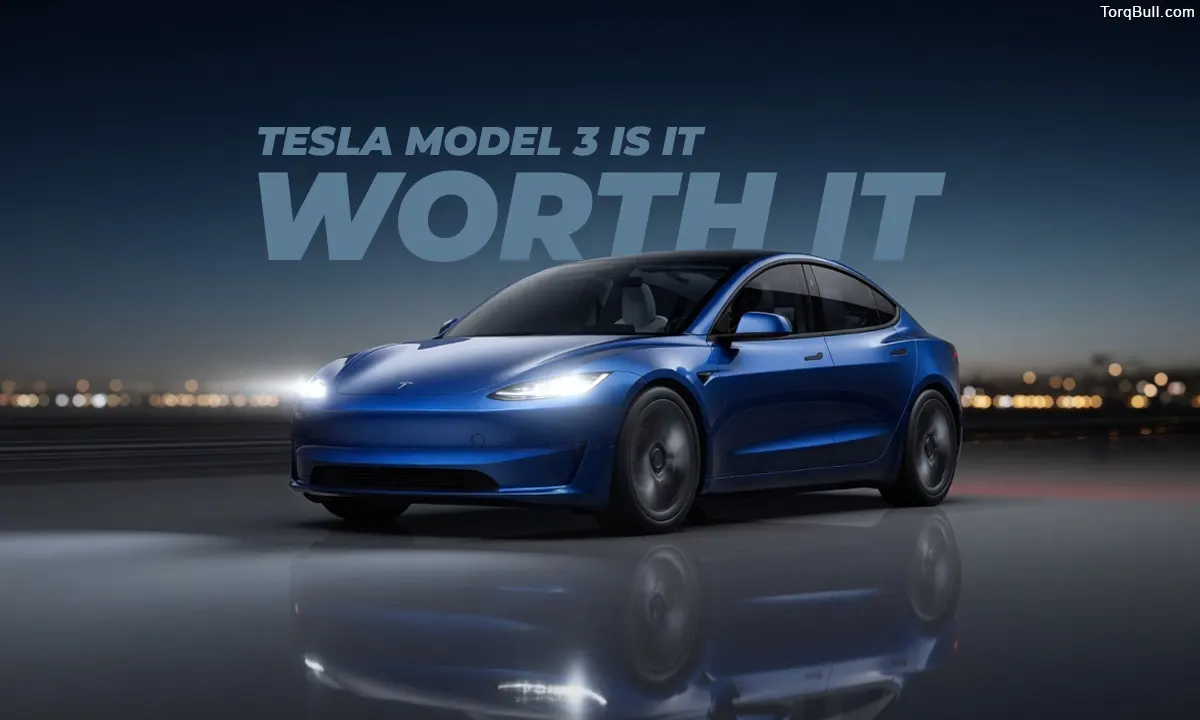
The Tesla Model 3 is the best-selling electric vehicle in the United States for good reason — it combines the longest EPA range in its class, genuine sports-car acceleration, over-the-air software updates that add features while the car sits in the driveway, and a Supercharger network so mature and reliable that road trip planning approaches the simplicity of a gasoline vehicle. U.S. News gives the 2026 Model 3 a score of 9.1 out of 10. Edmunds calls it one of their favourite EVs. KBB owners rate it 4.6 out of 5 stars. But worthy is not the same as universally appropriate — and the Model 3’s specific strengths and specific limitations make it a strongly worth-it purchase for certain buyer profiles and a less compelling choice for others. This guide provides the honest, complete answer for every type of buyer considering the Model 3 in 2026.
What the 2026 Tesla Model 3 Gets Undeniably Right
Range That Genuinely Covers Real-World Driving
The 2026 Tesla Model 3 lineup spans 303 to 363 miles of EPA-rated range depending on trim and wheel specification — with every configuration cracking the 300-mile mark that EV buyers consider a psychological and practical threshold. The Premium RWD at 363 miles is the efficiency leader of the lineup and, according to U.S. News, one of the longest-range luxury electric sedans available at its price point — second only to the significantly more expensive Lucid Air. Edmunds’ real-world range test of the Long Range AWD achieved 338 miles — 99 percent of its 341-mile EPA rating — a result that places it among the most accurate EPA representations in the segment. At 75 mph highway speed, real-world range falls to approximately 280 to 310 miles for the Long Range variants — still sufficient for the majority of American intercity drives without a charging stop.
Performance That Surprises at Every Trim Level
The 2026 Model 3’s acceleration figures are genuinely extraordinary across all configurations. The base RWD reaches 60 mph in 5.8 seconds — quick by any standard for a family sedan. The Premium AWD completes the sprint in 4.2 seconds. The Performance trim, with its 510 combined horsepower, reaches 60 mph in a claimed 2.9 seconds — faster than most dedicated sports cars available at any price. KBB owner reviews consistently cite performance as one of the Model 3’s strongest attributes, with one owner noting the Performance trim offers “neck-breaking speed” alongside genuine sport track suspension and handling balance that rivals dedicated performance vehicles costing significantly more.
The Supercharger Network: The Model 3’s Hidden Competitive Advantage
The Tesla Supercharger network — now numbering approximately 2,000 stations across the United States with ongoing expansion — is the most comprehensive, most reliable and fastest-charging public EV network available to any American EV owner. The 2026 Model 3 adds 100 miles of range in approximately 14 minutes at a V3 Supercharger according to Edmunds’ testing — a figure that translates to approximately 431 miles of range added per hour of charging. For road-tripping Model 3 owners, the Supercharger network effectively solves the range anxiety problem — not by eliminating charging stops but by making them predictable, fast and universally available across the routes most Americans drive.
Software That Improves With Age
Every Model 3 on American roads receives the same over-the-air software updates delivered silently, overnight, without a dealer visit or service appointment. Features like Grok AI voice assistant, enhanced trip statistics, improved Autopilot capability and new visualisation modes have been delivered to existing Model 3 owners who did not pay for them at purchase. A 2022 Model 3 in 2026 is not the same vehicle it was in 2022 — it has received years of software-driven improvement that keeps older hardware feeling current in ways that no other vehicle category reliably achieves.
Read: Tesla Model 3 RWD vs AWD: Performance, Range and Real-World Differences Explained
Low Running Costs That Compound Across Ownership
The Model 3’s annual energy cost of approximately $638 at national average home charging rates — a Self Financial study confirmed this as 71.68 percent lower than the average fuel cost across America’s 50 best-selling vehicles — combined with minimal routine maintenance requirements produces a running cost advantage that accumulates significantly over a five-year ownership period. No oil changes, no spark plugs, no transmission fluid, dramatically extended brake service intervals due to regenerative braking. Annual maintenance costs approximately $500 to $650 versus $1,000 to $1,400 for a comparable gasoline sedan.
Where the 2026 Tesla Model 3 Falls Short
Insurance Costs That Offset the Running Cost Advantage
The Model 3’s above-average insurance cost is the most significant financial counterweight to its fuel and maintenance savings. The national average full-coverage premium of $289 to $323 per month — approximately $300 to $600 more annually than a comparable Honda Accord or Toyota Camry — is driven by high repair costs, limited certified repair network availability and the vehicle’s elevated replacement value. Over five years, the insurance premium differential adds $1,500 to $3,000 to the total ownership cost relative to gasoline alternatives. Recharged’s honest assessment notes this directly: higher insurance costs are a real con worth taking seriously before purchase.
Touchscreen-Only Controls That Divide Owners
The Model 3’s commitment to screen-based operation of nearly all vehicle functions — including climate controls, mirror adjustment, steering column settings and the gear selector — is the most polarising aspect of the ownership experience. U.S. News notes that the touchscreen-based controls are “about as distracting as they get.” Edmunds confirms the touchscreen is a persistent point of complaint in owner feedback, noting “some owners face quality issues like panel gaps and squeaks, and there are complaints about the vehicle’s confusing controls.” For 2026, Tesla has restored physical stalks for turn signals and gear selection — a meaningful improvement over the stalk-free design of recent model years — but the climate control and mirror adjustment functions remain screen-dependent. This is not a limitation that adaptation fully resolves for all drivers, and buyers who strongly value tactile controls should experience a Model 3 as a daily driver before committing.
Depreciation on New Purchases
The 2026 Model 3’s 57 percent five-year depreciation rate — identified by iSeeCars as meaningfully higher than the Toyota Camry’s 35 percent or the Honda Accord’s 38 percent — is the single largest financial disadvantage of new vehicle purchase. A new Model 3 purchased at $38,380 today may be worth approximately $16,500 to $20,000 in five years, representing a depreciation loss of $18,000 to $21,880. Tesla’s history of price reductions — which have benefited new buyers while reducing the residual value of vehicles already in the used market — and the rapid pace of EV technology development both contribute to this elevated depreciation rate. Recharged’s analysis advises that new Model 3 buyers should be “exposed to the usual EV whiplash” of potential future price cuts and technology changes.
Service Experience Varies Significantly by Location
Tesla’s direct-to-consumer service model — no franchised dealer network, service concentrated in Tesla-operated centres and mobile service vans — produces very different ownership experiences depending on where the owner lives. In major metropolitan markets with multiple Tesla service locations, most common issues are addressed quickly, often through mobile service that requires no service centre visit. In markets with limited Tesla service infrastructure, owners report extended wait times for service appointments and reduced mobile service availability. This geographic variability in service experience is a real consideration that affects the worth-it calculation differently for urban and rural buyers.
The Worth-It Assessment by Buyer Profile
The Model 3 is clearly worth it for: Buyers who can charge at home on Level 2, drive 12,000 or more miles annually, plan to keep the vehicle for five or more years and live within reasonable proximity of Tesla service. At these parameters, the fuel and maintenance savings compound meaningfully, the Supercharger network provides road trip confidence, and the overall ownership experience consistently produces the 90 percent owner recommendation rate that KBB records. Recharged’s analysis specifically confirms that for drivers who log steady mileage, plan to keep the car a while and have home charging access, the annual cost of ownership is competitive with or lower than a similarly priced gasoline sedan.
The Model 3 is worth it with caveats for: Buyers in high-insurance states like California, Florida and Michigan where the premium differential versus gasoline alternatives is most pronounced — and for whom the worth-it calculation depends heavily on annual mileage and local electricity rates. Buyers in cold-climate markets who will experience meaningful winter range reduction and must plan charging stops more carefully. And buyers who prefer conventional automotive controls and will find the touchscreen-first interface a daily frustration rather than an accepted trade-off.
The Model 3 is less clearly worth it for: Buyers who cannot charge at home and will rely primarily on public DC fast charging at $0.35 to $0.42 per kilowatt-hour — which substantially narrows the fuel cost advantage. Buyers planning three years or fewer of ownership — where the depreciation penalty on a new vehicle purchase exceeds the fuel and maintenance savings. And buyers for whom build quality finish and cabin material quality are primary evaluation criteria — the Model 3’s interior quality, while improved in the Highland generation, remains a consistent complaint point in owner feedback that Edmunds’ analysis characterises as “not what I’d consider premium.”
Read: Total Cost of Owning a Tesla Model 3 In USA. Analysis That Every Buyer Needs Before Signing
Tesla Model 3 2026 — Is It Worth It? Complete Verdict Chart
| Buyer Profile | Worth It? | Primary Reason |
| Home charger, 15K+ miles/yr, 5+ yr ownership | Strongly yes | Fuel + maintenance savings compound fully |
| Home charger, 10K–15K miles/yr, 5 yr ownership | Yes | Running cost advantage outweighs premium |
| No home charger, public charging only | Neutral to no | Fuel cost advantage disappears on DC fast rates |
| Short ownership (under 3 years), new vehicle | No | Depreciation exceeds savings |
| Used 2021–2023 Model 3 buyer | Strongly yes | Depreciation absorbed; running savings intact |
| High-insurance state buyer (CA, FL, MI) | Conditional yes | Check local insurance quotes first |
| Cold-climate buyer (MN, ND, WI) | Conditional yes | Plan for 20–30% winter range reduction |
| Buyer valuing physical controls / traditional luxury | Neutral | Touchscreen-first design is a daily reality |
| Tech-forward buyer, frequent road tripper | Strongly yes | Supercharger network and software updates excel |
| Performance car buyer under $60,000 | Strongly yes | 2.9-sec 0-60 unmatched at price |
The Honest Bottom Line
The 2026 Tesla Model 3 is worth it for the majority of American buyers who evaluate it honestly against their specific lifestyle and financial circumstances — not because it is perfect, but because its genuine strengths in range, performance, software and running costs are substantial and real, while its limitations in insurance cost, depreciation on new purchases and touchscreen-centric controls are manageable for buyers who enter ownership with clear expectations.
Recharged’s summation captures the decision framework accurately: if you can charge at home, live within reach of Tesla service and are comfortable trading some interior refinement and traditional controls for technology and charging convenience, the Model 3 — new or used — still makes a lot of sense in 2026. The buyers for whom it makes the most sense are those purchasing a used 2021 to 2023 example at $24,000 to $30,000 — where the depreciation disadvantage has already been absorbed by the first owner, the running cost advantages remain fully intact, and the total five-year ownership cost genuinely undercuts a comparable gasoline or hybrid alternative for drivers who cover normal to above-average annual mileage.