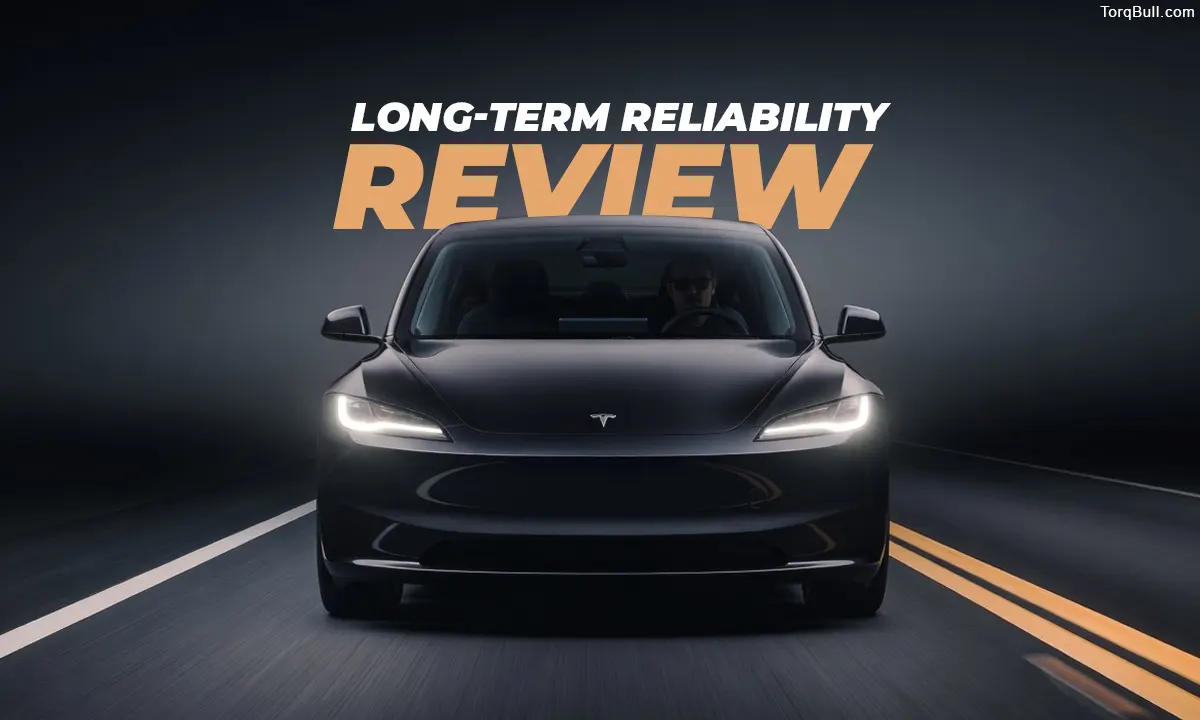
- ~85% battery capacity at 200,000 miles
- Many owners reach 150,000–200,000 miles without major repairs
- Strong drivetrain reliability over long term
- Common issues: suspension wear and software glitches
- Build quality and recalls remain key concerns
Tesla Model 3 Long-Term Reliability: The Tesla Model 3 has been in production since 2017 — long enough that the earliest examples are now eight to nine years old, many beyond their factory warranty windows and a significant number past 100,000, 150,000 and even 200,000 miles. This nine-year production history transforms what was once theoretical speculation about long-term reliability into one of the most substantial real-world EV durability datasets available to any automotive analyst, buyer or current owner. The verdict that emerges from this data is specific and nuanced: the Model 3’s powertrain — battery, motor and thermal management — has proven to be genuinely and remarkably durable across high mileage, substantially exceeding early industry scepticism about EV longevity. But the supporting systems — body construction, software stability, suspension components and brake maintenance requirements — produce a long-term ownership experience more variable than the powertrain’s strength alone would suggest. This complete guide synthesises all the available data into the definitive 2026 long-term reliability assessment.
Read: Tesla Model 3 Handling and Ride Comfort Review. Complete 2026 Assessment
Long-Term Battery Reliability: The Evidence at 100,000 and 200,000 Miles
The battery pack is the component that determines whether the Model 3’s long-term reliability story is positive or negative — because it is simultaneously the vehicle’s most expensive component and the one that most directly affects daily usability as the vehicle ages. The nine years of production data available in 2026 provides the clearest picture of any production EV’s battery longevity available anywhere in the industry.
Tesla’s 2023 Impact Report provides the most authoritative source: a graph of battery capacity retention across a statistically significant number of Model 3 and Model Y fleet vehicles, showing average capacity dropping to approximately 90 percent by 50,000 miles before levelling into a gradual fade that maintains comfortably above 80 percent at 200,000 miles. Tesla’s own fleet data confirms 85 percent average capacity at 200,000 miles with outliers on both sides of that figure. Edmunds separately confirms that EV batteries lose approximately 1 to 2 percent of range per year under typical driving conditions — projecting the Model 3’s estimated range at eight years to be approximately 288 miles from its 321 to 363-mile EPA-rated starting point, depending on trim.
This battery longevity data is not theoretical. High-mileage owner accounts from the Tesla Motors Club community, EV owner forums and automotive media long-term tests consistently validate it. Recharged’s 2026 long-term reliability analysis confirms that high-mileage owners routinely report 150,000 to 200,000 miles with modest range loss and no major drivetrain repairs. Top Gear’s long-term test of a 2021 Model 3 Long Range AWD, which accumulated 37,699 additional miles on a vehicle that had 30,000 miles at acquisition, calculated approximately 89 percent battery capacity remaining — an 11 percent loss that the reviewer specifically noted sits within one standard deviation of Tesla’s published fleet mean. The reviewer concluded that the battery was stable and that the next owner would very likely receive a car with predictable, consistent performance.
The practical implication for any current or prospective long-term Model 3 owner is direct: battery degradation on a well-managed Model 3 is a slow, predictable and non-catastrophic process whose endpoint after 200,000 miles — approximately 80 to 88 percent retained capacity — leaves a vehicle that still delivers 260 to 316 miles of effective range on the Long Range specification. This is not a vehicle that becomes unusable through battery decay. It is a vehicle that gradually becomes less capable of the longest road trips while remaining fully adequate for daily driving indefinitely. Complete battery pack failures remain statistically rare across the fleet — well under 1 percent of vehicles.
Long-Term Motor and Drivetrain Reliability: The True Durability Strength
The electric motors powering the Model 3 represent the single most straightforward long-term reliability advantage of EV ownership over conventional gasoline powertrains — and the area where the Model 3’s nine-year production history most consistently validates the theoretical engineering advantages of electric drive.
Unlike a gasoline engine with thousands of moving parts — pistons, connecting rods, valvetrain components, timing chains, oil pumps and hundreds of seals all experiencing cyclic mechanical stress — the Model 3’s electric motor has a single moving part: the rotor. It has no oil to degrade, no timing components to wear, no valves to burn and no combustion products to contaminate internal surfaces. The fundamental mechanical simplicity that this architecture enables translates directly into the long-term motor reliability data that nine years of Model 3 ownership has produced.
Major motor failures on Model 3 vehicles — defined as motor or gear unit replacement required outside the normal warranty claim process — remain extraordinary events rather than typical high-mileage occurrences. Owner accounts of 200,000-mile Model 3 examples virtually never mention motor replacement as a cost of that mileage. Most Model 3 drivetrains can exceed 300,000 miles according to the Auto Pro Nashville used vehicle analysis, a figure that, at 15,000 annual miles, represents 20 years of average-use operation. This long-term motor durability fundamentally changes the economics of high-mileage EV ownership compared to gasoline vehicles, where engine wear and transmission service dominate the repair cost profile at 100,000 to 200,000 miles.
Long-Term Build Quality and Body Reliability: Where the Picture Changes
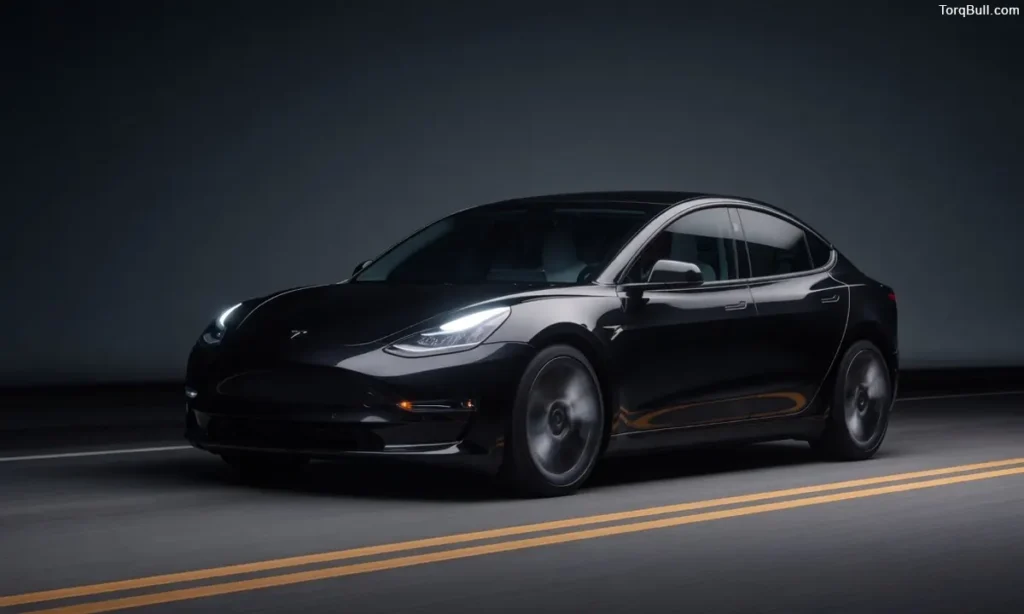
The powertrain’s exceptional long-term reliability is counterbalanced by a less consistent long-term performance record from the Model 3’s body construction, interior materials and physical build quality — and this is where the vehicle’s nine-year production history reveals the most meaningful variation between individual examples and production generations.
Top Gear’s long-term evaluation of a 2021 Model 3 Long Range observed that panel gaps and interior trim mismatches present from acquisition had not worsened across the evaluation period — confirming that Model 3 build quality problems are primarily manufacturing-origin issues rather than progressive structural failures. The existing issues remained, but they did not compound. A four-year, 18,000-mile real-world ownership account from Macfilos reported a completely trouble-free ownership experience with maintenance costs limited to one replacement tyre after a puncture — and confirmed that the vehicle passed all government safety inspections from year three onward with no faults detected.
However, these positive extended-ownership accounts are balanced by a very different data source. Germany’s TÜV 2025 inspection report — examining vehicles at periodic roadworthiness inspections rather than through owner self-reporting — ranks the Model 3 near the bottom of its age class with a higher-than-average defect rate for 2 to 5-year-old vehicles, specifically flagging suspension components, brakes and lighting systems as the most frequently cited defect categories. This European inspection data is particularly significant because it captures failures that owners may not report or even notice until a periodic professional inspection identifies them. The tension between high owner satisfaction scores and lower inspection agency ratings reflects this gap — owners focus on whether the car drives well and whether the battery works, while inspection agencies focus on whether all safety-adjacent systems meet minimum standards.
Software Reliability Over the Long Term: Updates as Both Solution and Problem
The Model 3’s over-the-air software update system has proven to be one of its most distinctive and double-edged long-term reliability characteristics across nine years of ownership experience.
The positive case is substantial. Tesla has used over-the-air updates to resolve safety recalls without requiring service centre visits, to improve battery management algorithms that have demonstrably extended battery life in existing vehicles, to add driver assistance features that did not exist at delivery and to improve the efficiency and accuracy of range estimation software. A 2020 Model 3 receives the same software interface and features as a 2025 model — a technology continuity that no other automotive manufacturer provides at equivalent scale. Top Gear’s long-term reviewer confirmed that a 2021 Model 3 and a 2025 Model 3 ran exactly the same software and interface — a remarkable testament to OTA update capability.
The negative case is equally real. Over-the-air updates occasionally introduce new software bugs that did not exist in the prior software version. Owner complaints about touchscreen freezes, camera display delays, driver assistance behaviour changes and unexpected feature removals following updates are consistent across owner forum discussions throughout the vehicle’s production history. Recharged’s 2026 long-term reliability analysis specifically notes that over-the-air updates fix some issues but also introduce occasional new bugs, and that owners report touchscreen freezes, camera glitches and driver assistance quirks more often than on simpler vehicles. Consumer Reports’ broader EV reliability data confirms that 40 percent of surveyed EV owners received an over-the-air update in the past 12 months — and only 27 percent found those updates beneficial.
Read: How to Update Tesla Model 3 Software Without Visiting the Dealer. Why Some Owners Never Get Them
Tesla Model 3 Long-Term Reliability — Comprehensive Assessment Chart
| System / Component | Long-Term Performance (100K–200K miles) | Reliability Grade | Key Finding |
| Battery capacity (NCA Long Range) | 85–88% retained at 200,000 miles | Excellent | Tesla fleet data; slow, predictable decline |
| Battery capacity (LFP Standard Range) | 88–92% retained at 150,000 miles | Excellent | Higher cycle life than NCA chemistry |
| Electric motor(s) | Rarely replaced; 300,000-mile capable | Exceptional | Fewest failure reports in class |
| Drivetrain (gearbox, inverter) | Durable; uncommon failures in data | Very Good | No fluid changes required |
| Software / touchscreen | Occasional freezes; update-related bugs | Average | OTA fixes issues but introduces new ones |
| Panel gaps / body alignment | Static defects; do not worsen over time | Below Average | Manufacturing-origin, not progressive |
| Paint durability | Thin clear coat; chips and fades | Below Average | Worse than German luxury competitors |
| Interior trim / rattles | Improves in later years; earlier cars rattle | Average | Generation-dependent; Highland better |
| Front suspension components | Wear accelerated by weight and torque | Fair | TÜV flags as above-average defect rate |
| Brake calipers / rotors | Corrosion risk; extended pad life | Fair (northern states) | Annual maintenance recommended |
| 12-volt auxiliary battery | 3–5 year replacement cycle | Average | Common surprise replacement item |
| Tyres | Faster wear than gasoline equivalents | Fair | Weight + torque; budget for earlier replacement |
The Long-Term Maintenance Cost Advantage: What Nine Years Shows
One of the most consistently validated long-term Model 3 ownership findings across nine years of real-world data is the substantially lower routine maintenance cost compared to equivalent gasoline vehicles — and the data confirms this advantage compounds meaningfully across extended ownership periods.
The complete absence of engine oil changes, timing chain service, spark plug replacement, exhaust system service, catalytic converter maintenance and transmission fluid changes eliminates the most frequent and most predictable cost items in any gasoline vehicle’s maintenance schedule. The Model 3’s regenerative braking system extends brake pad and rotor life to two to three times the typical gasoline vehicle interval. The four-year owner account from Macfilos reported maintenance costs limited to one tyre replacement — a total running cost extraordinarily low by any conventional automotive standard. Auto Pro Nashville’s used vehicle analysis confirms routine maintenance costs of approximately $400 to $600 per year for tyre rotations, cabin filters and wiper blades — far below the $1,000 to $1,400 annual maintenance cost typical of comparable gasoline midsize sedans.
The suspension and brake inspection costs that European TÜV data highlights as above-average concerns are real — but they are modest relative to the oil change, timing service and drivetrain maintenance costs they replace. The net long-term maintenance advantage remains firmly in the Model 3’s favour across extended ownership periods.
The Honest Long-Term Verdict: Who the Model 3 Serves Best Over Time
Nine years of production data produces a long-term reliability verdict that is specific enough to guide real purchase decisions. The Model 3 is an exceptional long-term ownership proposition for buyers whose primary concerns are powertrain durability and operating cost — categories where its battery and motor longevity, combined with dramatically lower maintenance costs, produce outcomes superior to any comparable gasoline vehicle available at equivalent price. It is a satisfactory but not exceptional long-term ownership proposition for buyers whose primary concerns are build quality consistency, interior material durability and software stability — categories where the vehicle’s performance is average to below-average against its price-point competition.
Recharged’s 2026 long-term reliability summation captures the essential balance accurately: the Model 3 is mechanically simpler than many gas cars and has fewer catastrophic engine-style failures, with its weak spots concentrated in build quality, software reliability and suspension wear — particularly in regions with poor roads or heavy winter use. For buyers who weight these factors appropriately and purchase with clear expectations about where the vehicle excels and where it falls short, the nine years of accumulated Model 3 reliability data is ultimately encouraging — a vehicle that is more durable where it matters most and more variable where the differences are least financially significant.

We just experienced a dead stop rear motor failure on our 2024 duel motor M3 with just over 2000 miles and less than 2 years on it (driven infrequently by my wife). It has been towed to the Tesla service center where it is “awaiting a part”. I am suspecting an inverter failure, I.e. an electronics failure. We shall see…