- ~54.5% depreciation over five years
- Estimated resale value around $16,800
- Market range: 45–60% of original MSRP
- Value depends on mileage, battery health and trim
- Used Model 3 can offer strong value if well maintained
Tesla Model 3 Resale Value: Resale value is the silent partner in every vehicle purchase decision — the number that determines how much of the purchase price is recovered when the owner sells or trades in, and therefore the number that determines the vehicle’s true annual cost of ownership more than any other single factor. For the Tesla Model 3, the resale value question in 2026 is more nuanced than at any previous point in the vehicle’s history, because the used Tesla market has experienced extraordinary volatility since 2021. The days of near-purchase-price resale and the pandemic-era speculation premium are firmly in the past. The current reality — based on iSeeCars analysis of 15 million vehicles, Recharged’s 2026 market data and KBB’s five-year cost-to-own projections — is that the Model 3 depreciates meaningfully in five years, retaining approximately 40 to 55 percent of original MSRP depending on the specific vehicle and market conditions. This guide explains every dimension of that range and what it means for both sellers and used buyers.
The Five-Year Depreciation Reality: What the Data Shows
Multiple independent sources converge on the same broad finding for five-year Tesla Model 3 depreciation, with some variation reflecting different methodology, assumed purchase prices and market timing.
iSeeCars’ analysis of over 15 million vehicle transactions places the Tesla Model 3’s five-year depreciation at 54.5 percent, resulting in a resale value of approximately $16,832 from the dataset’s assumed new selling price. This 54.5 percent figure compares unfavourably to the average five-year depreciation of 41.5 percent for all vehicles and 38.9 percent for all sedans — confirming that the Model 3 depreciates faster than the mainstream market average over a five-year period.
Recharged’s 2026 market analysis, drawing on current used Tesla listing prices and recent transaction data, places five-year Model 3 examples at approximately 45 to 60 percent of original MSRP — a range that reflects the significant variation between well-maintained, low-mileage, high-battery-health examples at the upper end and higher-mileage, hard-charged examples at the lower end. KBB’s five-year cost-to-own analysis for the 2026 Model 3 projects depreciation of $23,767 over five years from a purchase price in the $38,000 to $42,000 range, leaving a projected residual value of approximately $14,613 — consistent with the lower end of the iSeeCars and Recharged ranges.
The most important practical data point for any five-year Model 3 seller in 2026 is the current used market pricing for 2020 to 2021 Model 3 examples — the vehicles that are now approaching or past the five-year mark. Long Range AWD examples from 2020 to 2021 in good condition with 40,000 to 80,000 miles are broadly advertising in the low to upper $20,000 range across major American markets, according to Recharged’s April 2026 market survey. This real-market data provides the most grounded reference point for what a well-kept five-year Model 3 actually commands from genuine buyers — and it is meaningfully higher than the sub-$17,000 figure implied by the most pessimistic depreciation analyses, reflecting the Model 3’s continued demand strength relative to other EVs.
Read: Tesla Model 3 vs BMW i4: Which Electric Sedan Actually Wins?
The Depreciation Curve: When the Model 3 Loses the Most Value
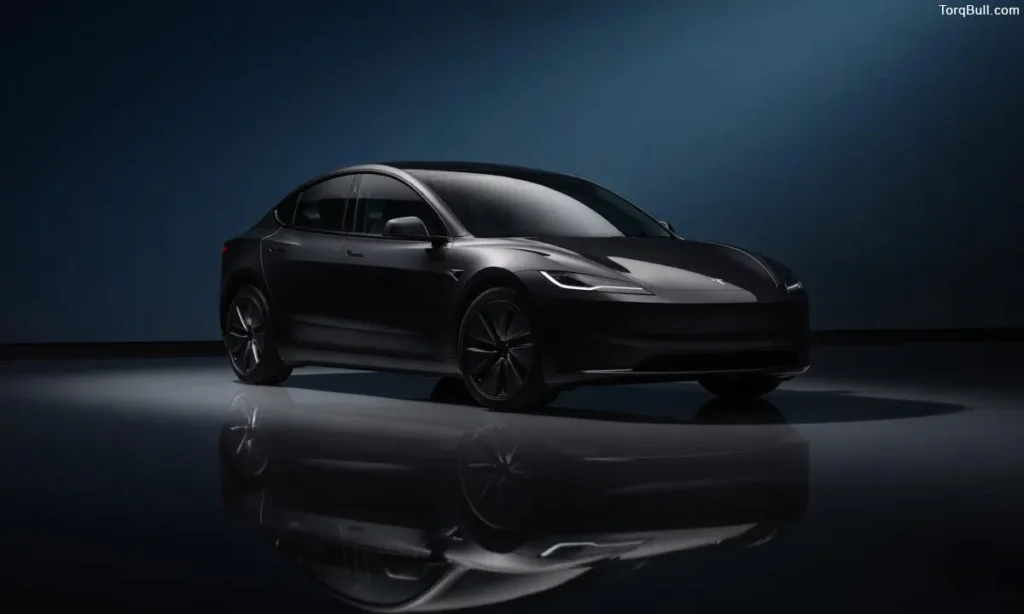
Understanding five-year resale value requires understanding the shape of the depreciation curve — because the Model 3’s value does not decline at a constant rate across the five-year period, and the timing of sale within that window has material financial consequences.
Year one is where the steepest depreciation occurs. A new Model 3 typically loses 20 to 25 percent of its sticker price in the first year as the vehicle transitions from new to used status, as Tesla’s pricing history creates uncertainty about future new-car prices and as the initial new-vehicle premium evaporates. Recharged’s data quantifies the first-year loss at approximately $6,000 to $8,000 for a typically priced new Model 3 — the largest dollar loss of any single year in the ownership cycle. This front-loading is consistent with most new vehicles but is amplified in Tesla’s case by the brand’s history of price reductions that directly affect used market valuations.
Years two and three continue significant depreciation, though at a reduced rate. By the end of year three, a Model 3 has typically lost approximately 52 to 60 percent of its original value according to combined iSeeCars and Recharged data — leaving approximately 40 to 48 percent of original MSRP intact. The three-year mark coincides with many lease returns and is therefore a point of high used inventory that keeps prices competitive with newer alternatives.
Years four and five see the depreciation rate flatten noticeably. Recharged describes this as the “flatter part of the curve” — where annual losses slow to approximately $1,500 to $2,500 per year rather than the $6,000 to $8,000 first-year loss. A five-year-old Model 3 in good condition with a healthy battery has already absorbed the steepest price declines and is entering the phase where the market treats it more like a conventional premium used sedan than an EV speculation asset. This is why buyers purchasing a four to five-year-old Model 3 absorb the most depreciation risk absorbed by the first owner while the vehicle still has substantial remaining utility and modern software capability.
Tesla Model 3 Five-Year Depreciation Timeline — Complete Reference Chart
| Ownership Year | Approximate Mileage | Typical Depreciation from MSRP | Value Retained (% of MSRP) | Est. Market Value ($42K purchase) | Annual Dollar Loss |
| New | 0 | 0% | 100% | $42,000 | — |
| Year 1 | ~13,500 | 20–25% | 75–80% | $31,500–$33,600 | $8,400–$10,500 |
| Year 2 | ~27,000 | 35–42% | 58–65% | $24,360–$27,300 | $4,200–$9,240 |
| Year 3 | ~40,500 | 45–55% | 45–55% | $18,900–$23,100 | $1,260–$8,400 |
| Year 4 | ~54,000 | 50–58% | 42–50% | $17,640–$21,000 | $1,260–$3,460 |
| Year 5 | ~67,500 | 54–62% | 38–46% | $15,960–$19,320 | $1,680–$3,460 |
| Year 7 | ~94,500 | 62–68% | 32–38% | $13,440–$15,960 | $1,260–$2,520 |
| Year 10 | ~135,000 | 70–75% | 25–30% | $10,500–$12,600 | $840–$1,680 |
All figures are estimates based on 2026 market data, iSeeCars analysis and Recharged trade-in research. Assumes good condition, average mileage, no accidents and healthy battery. Actual values vary significantly by trim, mileage, battery health and regional market conditions.
The Four Variables That Move Five-Year Resale Value by Thousands
The range between the best-case and worst-case five-year resale value for a Tesla Model 3 is approximately $8,000 to $12,000 on a $42,000 original purchase — a spread almost entirely explained by four specific variables that are partly within the owner’s control.
Battery health is the most distinctive and most financially impactful variable in Tesla Model 3 resale valuation — and the one that most differentiates EV resale from gasoline vehicle resale. A five-year Model 3 with a documented State of Health of 92 percent commands a meaningful premium over an equivalent model year example showing 82 percent State of Health, because the battery pack represents 30 to 40 percent of the vehicle’s total value and its condition directly determines the remaining range the next owner will experience. Recharged’s resale guidance is emphatic: battery health and software condition are now just as important as mileage and tyres when pricing a used Model 3. A verified high-SoH battery report, produced by a Tesla-compatible diagnostic tool or Tesla Service Center, can add $1,500 to $3,000 to a private party sale value compared to an equivalent undocumented example.
Charging history affects resale value primarily through its impact on battery health, but also directly through buyer perception. A Model 3 whose history shows predominantly Level 2 home charging with infrequent Supercharging is a more desirable used purchase than one showing extensive daily DC fast charging — and knowledgeable used EV buyers in 2026 are increasingly requesting charging history data alongside mileage. Tesla’s own records, accessible through the vehicle’s service history, provide some visibility into historical charging patterns.
Trim and wheel specification produce meaningful resale value differences between otherwise comparable examples. Long Range and Performance trims retain more absolute dollar value than Standard Range examples due to their higher original prices, though the percentage depreciation is similar. The 18-inch Photon wheel specification is preferable for range-conscious used buyers, while the 19-inch Sport wheels are preferred by drivers prioritising appearance — creating different buyer pools with different willingness to pay.
Timing relative to Tesla price changes is the factor least within an individual owner’s control but most dramatically demonstrated in the 2021 to 2025 period. Tesla’s price reductions on new Model 3 variants in 2023 — some exceeding $10,000 — directly reduced used market valuations for owners who purchased at the prior higher prices. Recharged’s guidance frames this honestly: “The used market doesn’t care what you paid; it cares what comparable new Teslas and competing EVs cost today.”
How the Model 3 Compares to Competing EVs in Resale Value
The Model 3’s five-year depreciation of 54 to 62 percent, while higher than the mainstream gasoline sedan average of 38.9 percent, represents among the best resale value performance in the EV segment. Autoblog’s February 2026 analysis confirms that in iSeeCars’ study, the Model 3 was the lowest-depreciating EV analysed — outperforming the Hyundai Ioniq 6, Chevrolet Bolt, Nissan Leaf, Volkswagen ID.4 and virtually all other mainstream EV alternatives on five-year value retention.
The JD Power 2026 U.S. ALG Residual Value Awards awarded Tesla three model-level wins — including recognition for the Model 3 — in the assessment of which new cars are projected to hold the highest percentage of MSRP after three years of ownership at open auction. This institutional recognition of the Model 3’s relative value retention reflects the vehicle’s sustained used market demand, powered by Supercharger network access, over-the-air software updates that keep older hardware feeling current, and the brand’s continued dominant position in the American EV market.
Read: Tesla Model 3 Battery Degradation After 100,000 Miles. What Separates The Best From The Worst Cases
The Used Buyer Perspective: Is a Five-Year Model 3 a Good Buy in 2026?
From the used buyer’s perspective, a five-year Model 3 available in the low to upper $20,000 range in 2026 represents one of the strongest used EV value propositions in the American market — precisely because the first owner has absorbed the steepest depreciation while the vehicle retains nearly all of its practical capability.
A 2021 Long Range AWD at $24,000 to $28,000 provides approximately 310 to 340 miles of EPA-rated range — reduced by 8 to 12 percent from the original rating due to typical battery aging — Supercharger network access, full over-the-air update capability and the same Autopilot hardware as a new vehicle. At $24,000, this vehicle delivers equivalent daily transportation capability to a new Model 3 at $38,380 at $14,380 less in purchase price — with the depreciation curve already flattened such that future annual value loss is approximately $1,500 to $2,000 rather than the $8,000 first-year loss the original buyer absorbed.
The key due diligence step for any five-year Model 3 used purchase — as established throughout this analysis — is verifying battery State of Health before finalising the purchase price. A battery at 90 percent SoH versus one at 81 percent on otherwise equivalent vehicles justifies a material price premium, and a formal diagnostic report provides the documentation needed to negotiate confidently in either direction.