The car dashboard has been on death row for a while, and most of us cheered the first execution. For decades, the dash was a wall of physical buttons and knobs. Then automakers swept them away and replaced them with enormous touchscreens, which felt futuristic right up until you tried to change the cabin temperature while doing 70 mph and found yourself three menus deep, eyes off the road, silently cursing.
That touchscreen era is now ending too, and this time the executioner is artificial intelligence. At CES 2026, the world’s biggest tech show, the message was unmistakable: the age of the AI-defined vehicle has arrived, with artificial intelligence becoming the core operating principle for how cars are designed and experienced, not just a feature bolted on top.
The result is a genuine reimagining of car tech, one where you talk to your car like a friend, the screen dissolves into the glass, and the vehicle anticipates what you need before you ask. It’s exciting, it’s already arriving, and it comes with some real catches you need to know about. Let me walk you through the death of the dashboard.
The Core Death: Menu-Diving Is Over
Here’s the shift at the heart of everything. We have officially moved past the era where massive touchscreens were the ultimate symbol of automotive luxury, and forcing a driver to navigate three sub-menus at speed just to adjust the climate is no longer considered cutting-edge, it’s considered a safety hazard. That’s a remarkable admission from the industry that spent a decade selling us bigger and bigger screens.
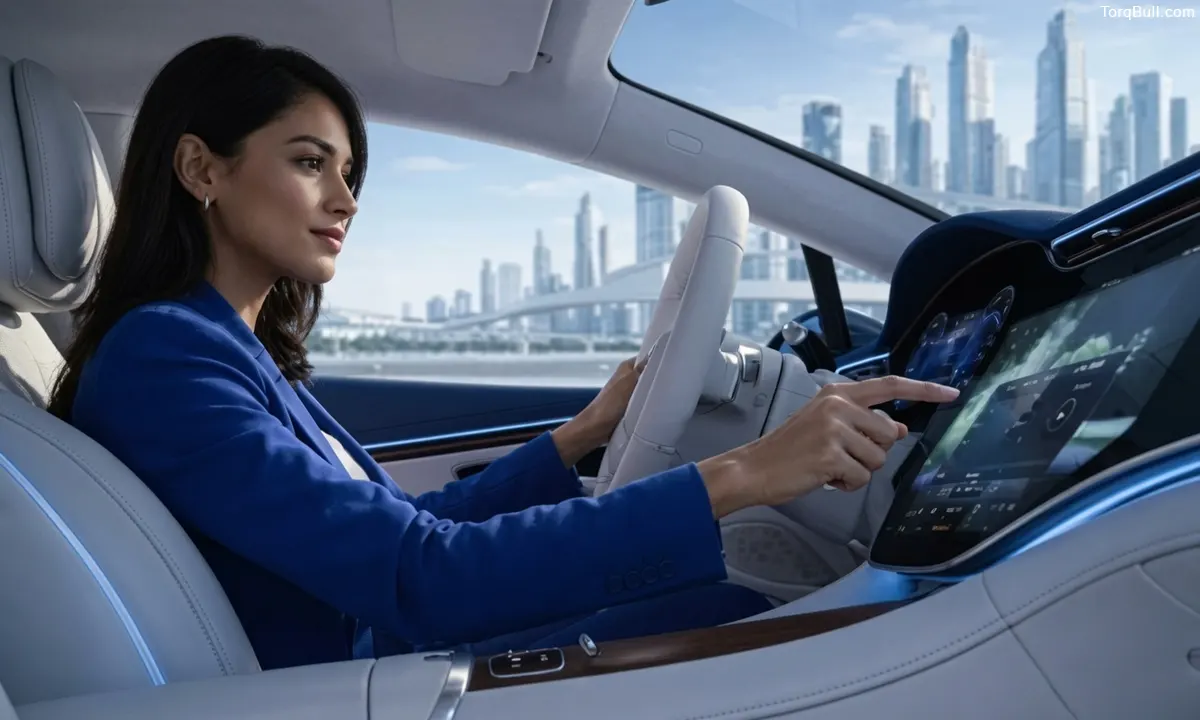
What replaces the menu maze is conversation. Old in-car voice assistants were rigid and dumb, choking on accents and handling only pre-programmed commands like “call John.” The new ones, powered by large language models, understand natural speech. You can say something like, “Hey car, I’m low on battery, find me a fast charger that’s still open and cheap,” and it just works, checking prices and charging speeds in real time. No screen-tapping required.
And drivers want this badly. Around 76 percent of US drivers say they want generative AI in their cars, and they want it fast, with 70 percent expecting voice commands to happen in under a second. Top systems now target response times under 500 milliseconds. When the interface is a genuine conversation instead of a button hunt, the dashboard as a control panel becomes almost irrelevant.
The Assistants Are Already Here
This isn’t a concept-car fantasy. The AI cabin is shipping right now. The BMW iX3 became the first production car with Amazon’s Alexa+ built in, a cloud-based large language model that lets drivers converse naturally to get information and adjust settings hands-free. Mercedes rolled out its AI-powered MB.OS operating system with integrated Microsoft and Google intelligence for smarter voice commands. Sony Honda’s AFEELA introduced a Personal Agent built on Azure OpenAI for natural, personalized dialogue.
The list keeps going. Ford is rolling out an AI assistant to up to 8 million customers through its app in early 2026, with deep integration into vehicles by 2027. Volkswagen is using ChatGPT for navigation and maintenance tips, and Tesla has its own AI called Grok for general questions. Even suppliers are in on it, with Bosch unveiling an AI platform that upgrades existing cockpits into intelligent, self-learning partners. Whatever you drive next, odds are it’ll want to have a conversation.
Your Car Now Anticipates and Cares
Here’s where it gets genuinely futuristic. The AI-defined car doesn’t just respond, it anticipates. These systems are self-learning, understanding your routines, preferences, and context, so the vehicle transforms from a simple means of transport into an intelligent partner that knows you.
It also watches out for you. Some systems can detect fatigue in your voice and suggest you take a break, while the 2026 Toyota RAV4 uses computer vision to warn you if you’re distracted, and occupant-presence reminders make sure you don’t forget a child or bag in the back seat. Looking ahead, AI assistants may reserve EV charging spots before you arrive, coordinate routes with real-time traffic lights, and handle toll payments autonomously. The cabin is becoming a smart space that actively looks after you, not just a box with a screen.
The Screen Itself Is Dissolving
The death of the dashboard isn’t only about voice replacing buttons. The physical screen is disappearing too, melting into the car’s surfaces. The single biggest wow of CES 2026 was a full-windshield holographic display that transforms the entire windshield into a display surface, with mass production slated for 2029.
Displays are also getting smarter about who’s looking. One dual-view OLED shows different content depending on viewing position, so the driver sees navigation while the passenger watches a movie on the very same screen. Another debuted the world’s first full-screen automotive display with a hidden in-screen infrared driver-monitoring camera, keeping clean aesthetics while enabling attention monitoring. The dashboard as a distinct physical object, a slab of plastic full of vents and buttons, is dissolving into intelligent glass.
Read: Level 3 vs. Level 4: The Hidden Tech Shift Changing Driving Forever
How the Dashboard Is Being Reimagined
Here’s the old world versus the new one.
| Old Dashboard | AI-Reimagined Cabin |
| Physical buttons and knobs | Natural-language voice |
| Menu-diving touchscreens | Conversational AI that “just works” |
| Static, locked at purchase | Software-defined, improves via OTA |
| Reacts to your inputs | Anticipates your needs |
| Fixed screen slabs | Holographic, context-aware displays |
| Generic for everyone | Self-learning and personalized |
Underpinning all of it is the software-defined vehicle, where your car behaves like a smartphone, getting better over time through over-the-air updates without a dealer visit, powered by staggeringly capable new chips delivering hundreds of trillions of operations per second. The smart cockpit market is racing toward $44 billion, and in-vehicle infotainment is approaching near-universal penetration. This is a well-funded, industry-wide revolution, not a niche experiment.
Let Me Be Honest About the Catches
I’m genuinely excited, but I’d be doing you a disservice if I only cheered, because the AI dashboard raises real concerns. Start with reliability. When voice becomes the primary interface, it must be as reliable as a mechanical switch, which is why the smart approach is hybrid, processing core functions on the device itself so that even with zero bars of signal, you never lose the ability to roll down a window or call for help. An AI interface that lags or locks you out because the cloud hiccupped isn’t futuristic, it’s dangerous.
Then there’s privacy. A car with interior scene understanding, cabin cameras, driver monitoring, and always-listening microphones is a car that is constantly watching and hearing you. Who owns that data, and where does it go? That question deserves a real answer before we hand our cabins over to the algorithms.
There’s also a distraction paradox worth naming. Replacing menu-diving with conversation is genuinely safer for complex tasks, but voice isn’t always better than a good physical control. A volume knob or a temperature dial is instant and eyes-free, while asking an AI to do the same can be slower and clunkier. The industry over-corrected once, ripping out buttons for touchscreens that became hazards, and it could over-correct again by assuming AI should do everything. And software-defined cars carry their own downside, since features can be locked behind subscriptions and your “owned” car increasingly depends on the maker’s servers and goodwill.
Here’s my read, though. None of these caveats mean the AI reimagining is bad. They mean it has to be done right, with reliable on-device fallbacks, honest data practices, and the humility to keep a few physical controls for the simple stuff. The menu maze absolutely deserves to die. What replaces it just needs to be better, not merely flashier.
Verdict: Cheer the Death, but Demand Better
So is the death of the dashboard something to celebrate? Mostly yes, and I say that as someone who has cursed at a buried climate menu more times than I can count.
The traditional dashboard, first the button wall and then the menu-maze touchscreen, genuinely deserves its fate. AI is turning the car into a conversational, anticipatory, self-learning partner that removes the dangerous screen-diving, personalizes the whole experience, watches for your fatigue, and updates itself like a phone. The examples are real and shipping, from Alexa-powered BMWs to ChatGPT-equipped Volkswagens, and the screen itself is evolving into intelligent, holographic, context-aware glass. This is one of the most exciting shifts in car tech in a generation, and CES 2026 confirmed it’s not hype, it’s happening.
But I’ll only fully cheer the death of the dashboard if what replaces it is more reliable and more private than the knob it’s killing, not just more impressive in a demo. The best AI car tech disappears into pure helpfulness, understanding “find me a cheap open charger” in plain English and simply doing it. The worst version replaces one distraction with a chattier one, watches your every move without telling you where the data goes, and locks the heated seats you paid for behind a monthly fee. The difference between those two futures is everything.
Here’s how I’d navigate it as a buyer. Embrace the AI assistant for what it does brilliantly, the complex, conversational, anticipatory tasks that touchscreens made miserable. But value the cars that keep a few real physical controls for the simple stuff, that process core functions on-device so they never leave you stranded, and that are transparent about your data. The dashboard you grew up with is dying, and that’s genuinely good news. Just make sure the intelligent cabin replacing it earns your trust as thoroughly as it wins your imagination. The future of car tech is a conversation. Let’s make sure it’s one worth having.