Forty Years of Dominance. The Suzuki GSX-R1000 The Superbike That Changed Everything
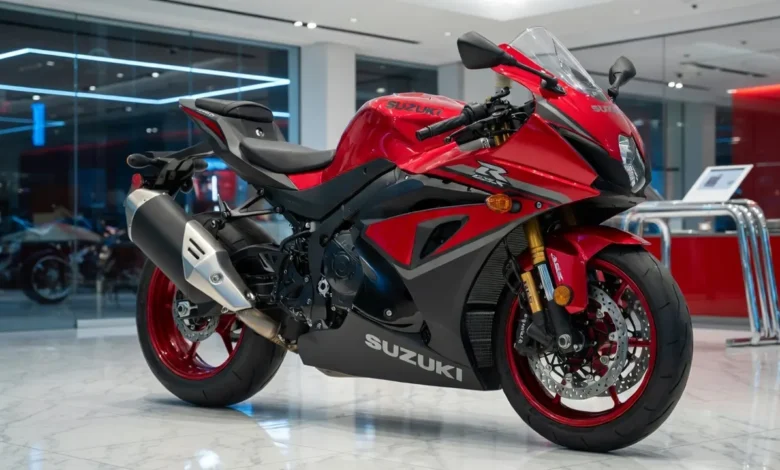
- Legacy since 2001 redefining the liter-class superbike segment
- Updated 999.8cc inline-four with variable valve timing
- Reinforced crankshaft and high 13.8:1 compression ratio
- Showa Balance Free suspension for advanced handling
- Bosch six-axis IMU delivering race-derived electronics and control
There are motorcycles that sell well, motorcycles that receive critical praise and motorcycles that win races. Very occasionally, there is a motorcycle that does all three simultaneously while also changing the fundamental direction of an entire market segment and redefining what every competitor must achieve simply to remain relevant. The Suzuki GSX-R1000 is one of those motorcycles — a machine whose 2001 debut upended the established superbike hierarchy with such completeness and conviction that its legacy has shaped every liter-class sportsbike developed in the quarter century since. As the GSX-R family celebrates its 40th anniversary and Suzuki delivers the first meaningful update to the GSX-R1000 platform since 2017, the story of this motorcycle — where it came from, what it became and where it is now — deserves telling in full.
The GSX-R Lineage: Born Racing in 1985
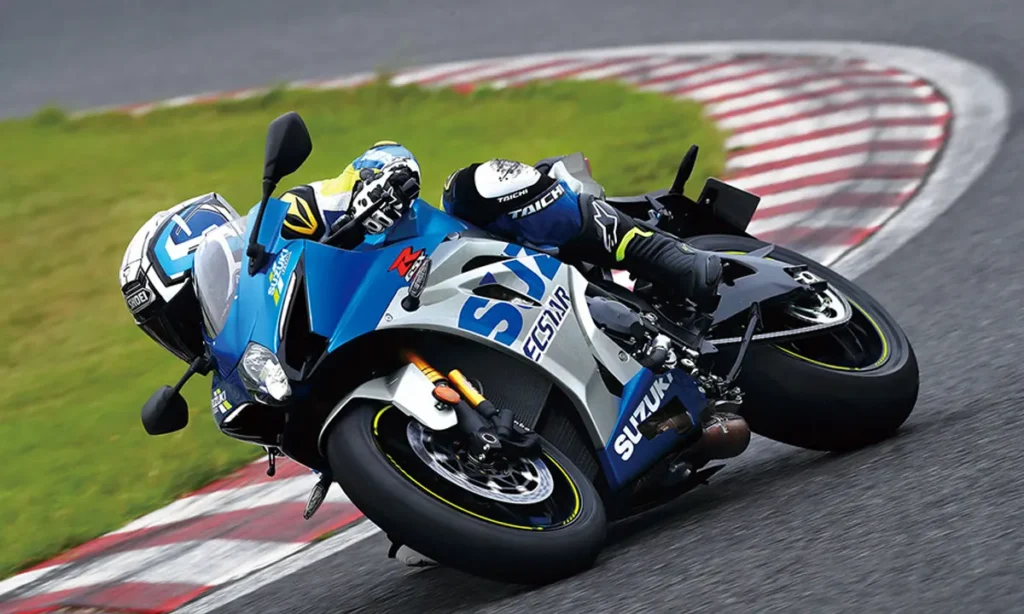
The GSX-R name first appeared in 1985, attached to a 750cc machine that was genuinely revolutionary in its context — a street-legal motorcycle built around racing architecture, lightweight construction and a philosophy that refused to accept the compromise between road usability and competition performance that defined every alternative available at the time. That original GSX-R750 established the template that every subsequent GSX-R would follow: race-derived technology, accessible performance and the relentless engineering discipline that prioritises what matters on the road and circuit over what photographs well in a showroom.
The GSX-R1000’s arrival in 2001 applied that philosophy to the liter class with consequences that the motorcycle industry absorbed for years afterward. Lighter, more powerful and more dynamically capable than the Honda CBR900RR and Yamaha YZF-R1 that had previously defined the category’s ceiling, the original GSX-R1000 did not merely join the liter-class competition — it restructured it entirely. The motorcycle went on to dominate production-based superbike, superstock and endurance racing worldwide, accumulating victories behind riders whose names became as synonymous with the GSX-R badge as the engineering beneath them — Kevin Schwantz’s fearlessness, Mat Mladin’s calculated aggression, Ben Spies’ measured precision across his multiple AMA Superbike championship seasons.
The 2017 Architecture: Variable Valve Timing Changes the Formula
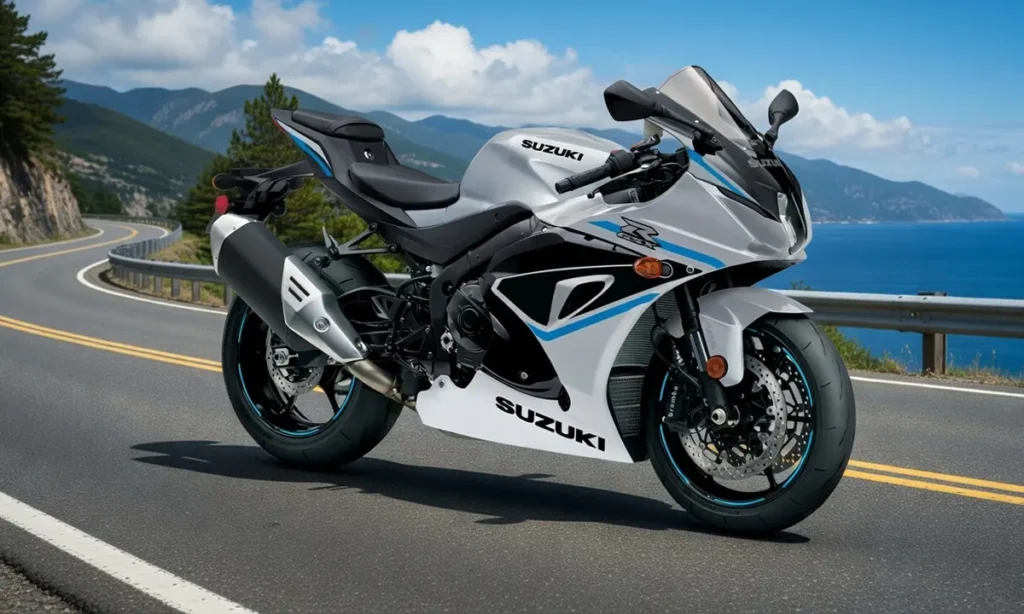
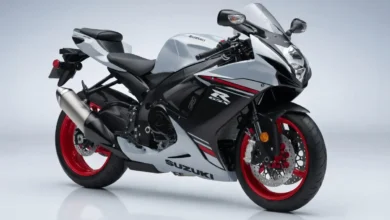
The current-generation GSX-R1000 platform — introduced in 2017 and carrying the internal designation L7 — represented the most technically ambitious revision in the model’s history at the time of its arrival. Two innovations distinguished it from every superbike that preceded it: Suzuki Racing Valve Timing (SR-VVT), which adjusts intake camshaft timing across a range determined by engine speed and throttle position to deliver both strong low-to-mid-range torque and high-revving top-end power from a single engine map, and the Racing Finger Follower valve train, which reduced the moving mass of each valve actuation component to just three grams — a figure that enabled higher revving capability, faster valve response and reduced internal friction simultaneously.
The twin-spar aluminium frame, designed using Finite Element Method analysis to concentrate rigidity precisely where structural demands are greatest, came in ten percent lighter than the generation it replaced while delivering improved chassis stiffness. The R-specification model added Showa’s Balance Free Front Fork and Balance Free Rear Cushion technology — race-derived damping systems that control damping force outside the shock body rather than within it, producing a level of surface responsiveness and chassis feedback that set a new standard for production superbikes. Brembo Monobloc four-piston calipers clamping 320mm rotors provided the stopping performance appropriate to the chassis and engine’s combined output.
This was a platform good enough to remain competitive across multiple model years — which is precisely what it has done, receiving colour updates and specification refinements while its fundamental architecture continued to represent credible superbike engineering through to the 2025 model year.
The 2026 Update: First Major Revision Since 2017
The 2026 GSX-R1000 and GSX-R1000R — arriving in dealerships in Spring 2026 and carrying 40th anniversary livery celebrating the GSX-R family’s four-decade heritage — represent the most comprehensive revision to the L7 platform since its original introduction, addressing every area of the motorcycle’s specification that nine years of superbike development had identified as requiring attention.
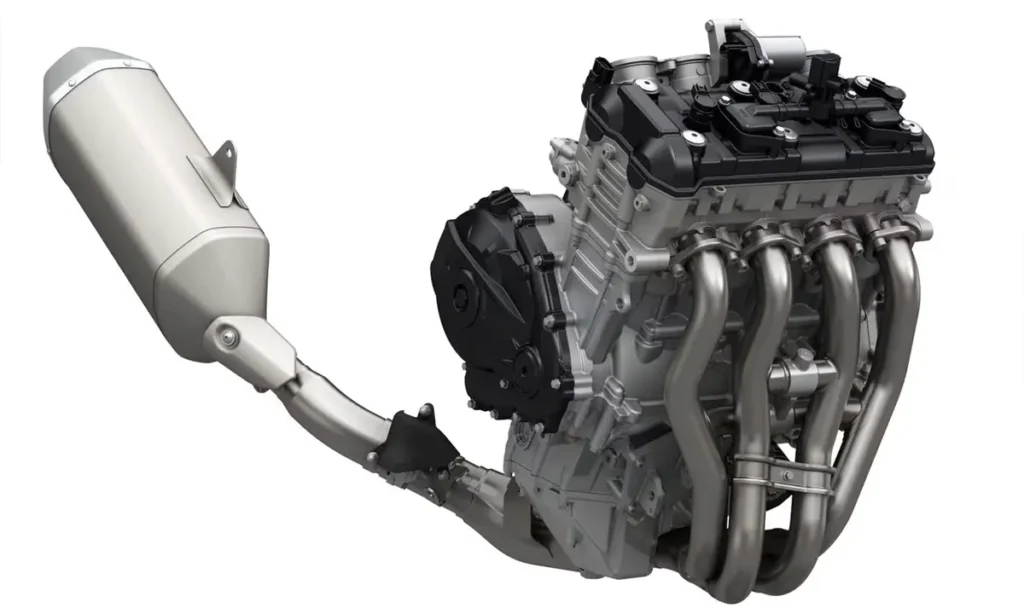
The engine receives the most extensive changes. New crankcases with larger-diameter journal bearings support higher output loads and improve durability under sustained race use. A revised cylinder head features modified intake and exhaust ports for greater flow efficiency, matched by larger intake and exhaust valves made possible by revised piston crown geometry. Compression ratio rises from 13.2:1 to 13.8:1 — a meaningful increase whose effect on combustion efficiency and power character is felt throughout the rev range. Throttle bodies grow from 46mm to 48mm. A wider cam chain reduces frictional loss particularly at high engine speeds during sprint and endurance competition. The entire 4-2-1 exhaust system is redesigned, with the collector repositioned closer to the engine for improved mass centralisation — a packaging decision that also helps the catalytic converter reach operating temperature more rapidly for emissions compliance. The new exhaust features a titanium muffler.
The electronics suite receives its most significant update since the L7 platform’s launch. The latest Bosch six-axis, three-direction IMU enables a generation of rider assistance systems that were unavailable when the platform debuted: Roll Torque Control, which manages the natural rolling torque that acts on the chassis under acceleration; Motion Track Anti-Lock Braking, which adjusts ABS intervention thresholds in response to lean angle and deceleration rate simultaneously; and a Lift Limiter that manages front wheel rise during hard acceleration with greater precision than the wheelie control systems it replaces. The traction control system expands to ten operating levels plus an off setting, accessible through three riding modes whose configuration the rider can adjust to preference.
A new lightweight lithium-ion battery reduces weight while providing more stable voltage delivery under the electrical loading demands of full-power circuit use. Optional winglets — inspired by the design used on Suzuki’s Suzuka 8-hour race entries — are available as an accessory, providing downforce-generated stability at circuit speeds without contributing permanent aerodynamic drag to the base specification. The GSX-R1000R’s fully adjustable swingarm pivot position — a feature directly derived from race preparation practice — allows chassis geometry adjustment that trail and road bikes at any price rarely offer.
Read: How Much Does the 2026 Yamaha R7 Cost? Is It Worth Every Dollar?
GSX-R1000 and GSX-R1000R — Complete Specifications (2025 / 2026)
| Category | GSX-R1000 (2025) | GSX-R1000R (2026 Updated) |
| Engine | 999.8cc Liquid-Cooled DOHC Inline-Four | 999.8cc — Revised Cylinder Head, Larger Valves |
| Variable Valve Timing | SR-VVT (Intake) | SR-VVT (Refined for 2026) |
| Valve Train | Racing Finger Follower | Racing Finger Follower |
| Compression Ratio | 13.2:1 | 13.8:1 |
| Power Output | ~199 hp | ~192 hp @ 13,200 rpm (Euro 5+ Compliant) |
| Peak Torque | ~83 lb-ft | 81.1 lb-ft @ 11,000 rpm |
| Throttle Bodies | 46mm | 48mm (Enlarged for 2026) |
| Exhaust | 4-2-1 Stainless Steel | 4-2-1 — Titanium Muffler, New for 2026 |
| Transmission | 6-Speed Close-Ratio | 6-Speed — GP-Shift Pattern Available |
| Quickshifter | Bi-Directional Standard | Bi-Directional Standard |
| Frame | Twin-Spar Aluminium | Twin-Spar Aluminium — Swingarm Pivot Adjustable (R) |
| Front Suspension | Showa BPF — Fully Adjustable | Showa BFF — Race-Level Damping |
| Rear Suspension | Showa Remote Reservoir Shock | Showa BFRC-Lite — Fully Adjustable |
| Front Brakes | Brembo Monobloc, 320mm | Brembo Monobloc, 320mm + Steel Braided Lines (R) |
| IMU | 6-Axis Bosch | 6-Axis Bosch — Updated Lightweight Unit (2026) |
| Traction Control | 10 Levels + Off | 10 Levels + Off — Smart TLR (TC / Lift / Roll) |
| ABS | Motion Track — Lean Sensitive | Motion Track — Updated Calibration (2026) |
| Launch Control | Standard | Updated Calibration (2026) |
| Battery | Lead-Acid | Lithium-Ion (2026) |
| Seat Height | 32.48 inches / 825mm | 32.48 inches / 825mm |
| Fuel Capacity | 4.2 gallons / 16 litres | 4.2 gallons / 16 litres |
| Tyres | Bridgestone RS11 | Bridgestone RS11 |
| Winglets | No | Optional Accessory (2026) |
| Starting MSRP (USA, 2025) | $16,499 | $18,649 |
| 40th Anniversary Livery | Available (2026) | Available (2026) |
Read: The Lightest Panigale Ever Built. The 2025 Ducati Panigale V2 S Fully Explained
Why the GSX-R1000 Still Matters
In a superbike segment whose upper echelon now includes machines priced at $24,000 to $32,000 — the Ducati Panigale V4, Honda CBR1000RR-R Fireblade SP and BMW M1000RR — the GSX-R1000’s positioning as a sub-$20,000 machine without compromising the essential engineering quality of its chassis, suspension, brakes and electronics represents a value argument that no competitor currently answers with equivalent conviction. The 2026 update that arrives after nine years of the current platform’s production confirms that Suzuki’s commitment to the nameplate’s future is not ceremonial but substantive — backed by the kind of engineering investment that only a manufacturer with genuine confidence in the market’s continued appetite for the GSX-R name would undertake. Forty years after the original GSX-R750 changed the rules, the Suzuki GSX-R1000 is still writing them.