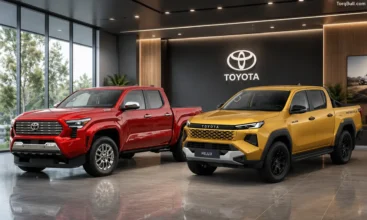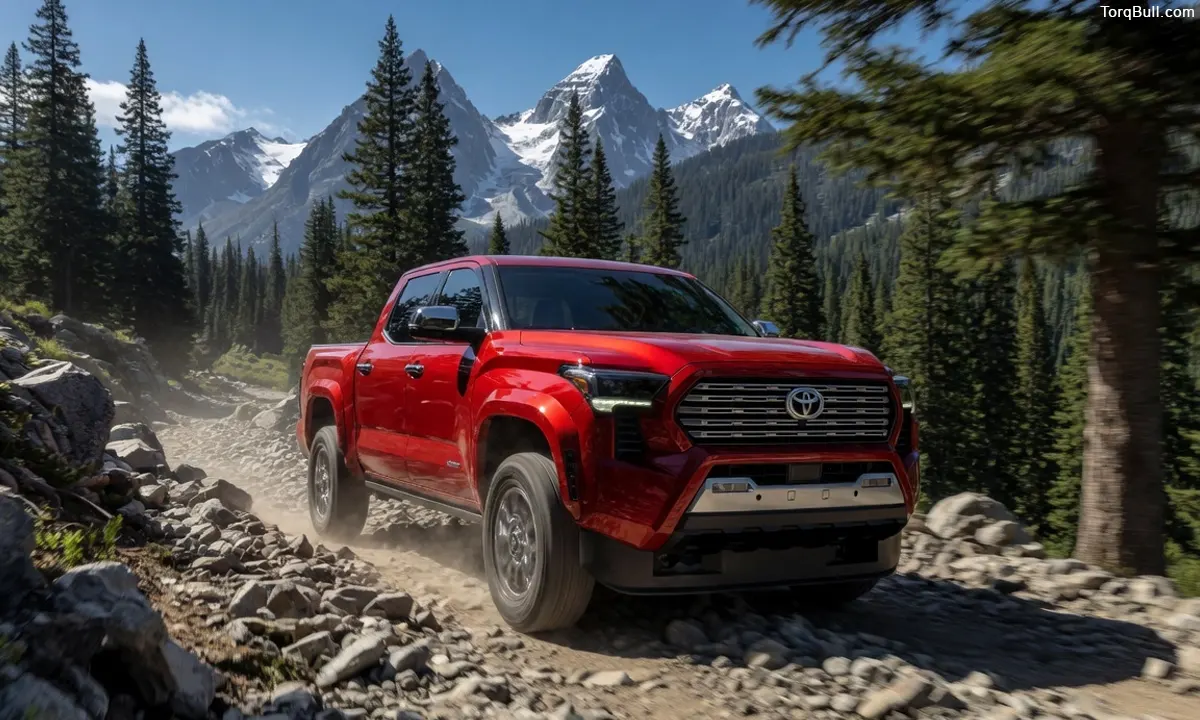
- The Toyota Tacoma TRD Off-Road uses Bilstein shocks, Crawl Control, Multi-Terrain Select and a locking rear differential to boost traction and stability on difficult terrain.
- Crawl Control acts like off-road cruise control, while Multi-Terrain Select optimizes power delivery across multiple surface conditions.
- The Toyota Tacoma TRD Pro adds FOX QS3 shocks, IsoDynamic seats and a front stabilizer disconnect for exceptional wheel articulation and rock-crawling capability.
The Toyota Tacoma’s enduring dominance of the midsize truck segment is built on a specific and substantiated off-road capability reputation — not brand loyalty alone, but decades of genuine engineering investment in the specific hardware, electronics and chassis design decisions that translate to trail performance. The 2026 Tacoma’s fourth-generation platform, introduced for 2024 and refined through 2025 and 2026, represents the most sophisticated expression of Tacoma off-road engineering available since the nameplate launched. Understanding exactly how each off-road system works — what Crawl Control does, what Multi-Terrain Select adjusts, why the Bilstein shocks on the TRD Off-Road differ from the FOX shocks on the TRD Pro and how the i-Force MAX hybrid’s instant torque changes the off-road experience — is the knowledge that separates an informed Tacoma purchase from one based on sticker and colour alone.
The Foundation: 4WD System and Drivetrain Architecture
The Toyota Tacoma’s off-road capability begins with its four-wheel drive system architecture — the mechanical foundation on which all electronic assistance systems operate. The 2026 Tacoma offers three distinct drivetrain configurations across its trim levels.
Part-time 4WD — designated 4WDemand by Toyota — is the standard configuration for most TRD Off-Road and other off-road-capable trims. In this configuration, the driver selects 2H for normal driving, 4H for high-speed four-wheel drive use on loose or slippery surfaces and 4L for low-range four-wheel drive at slow speed with maximum torque multiplication. The low-range transfer case reduces the drive ratio by approximately 2.7:1 in 4L — multiplying the engine’s available torque by this factor and enabling the extremely slow, controlled movement that technical rock crawling and steep grade descents require.
Full-time 4WD is available exclusively on Limited trim levels and uses an electronic locking centre differential that distributes power between front and rear axles continuously. This configuration provides permanent four-wheel drive engagement without driver intervention, with the locking capability specifically useful when the electronic system’s default torque distribution is insufficient for extreme conditions.
The electronically activated locking rear differential — available on TRD Off-Road, TRD Pro and Trailhunter trims — is one of the most practically significant off-road hardware items on any Tacoma configuration. When engaged, it splits power to the rear wheels on a 50-50 basis regardless of which wheel has better traction. In situations where one rear wheel is completely off the ground or in contact with zero-traction ice or mud, the locking differential ensures the remaining rear wheel continues to receive power — a mechanical capability that no amount of traction control programming fully replicates. Toyota’s official specification specifically notes that the locking rear differential activates when traction is extremely limited — the hardware of last resort before a recovery strap becomes necessary.
Read: Toyota Tacoma TRD Pro Full Review 2026. The Off-Road Flagship Assessed
Crawl Control: Off-Road Cruise Control Explained
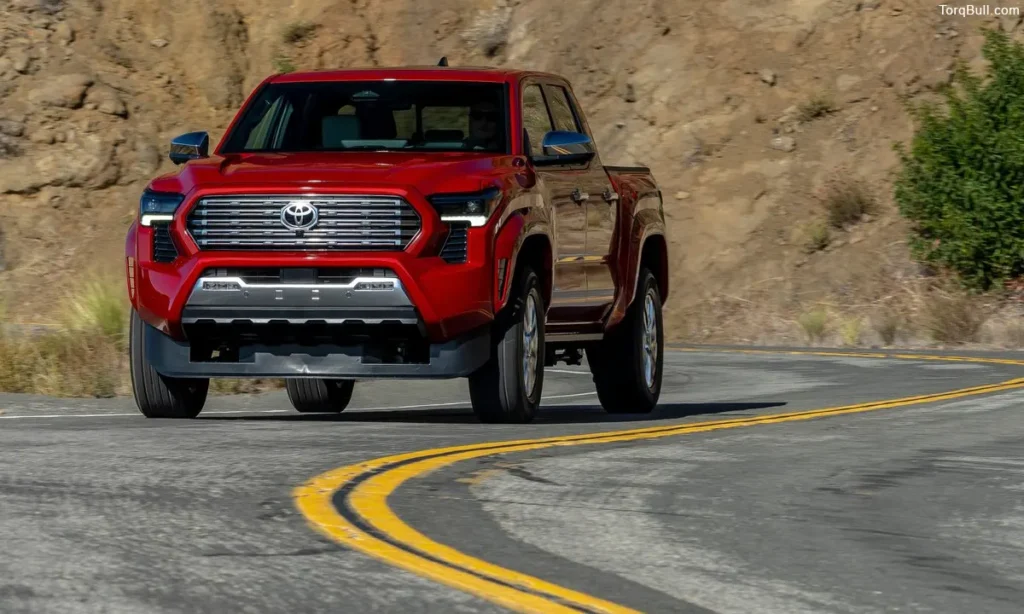
Crawl Control is one of Toyota’s most practically useful off-road assistance technologies and one of the most commonly misunderstood. It is not a stability control system or a traction control enhancement — it is specifically an automatic throttle and brake management system that acts as a low-speed, off-road cruise control.
When the driver engages Crawl Control and selects a target speed from five available settings — each progressively faster from walking pace through approximately 15 kilometres per hour — the system automatically manages all throttle input and individual wheel braking to maintain the selected pace regardless of terrain variation. The driver’s sole responsibility while Crawl Control is active is steering — no throttle management, no brake application and no concern about maintaining a consistent crawl speed across obstacles that would otherwise require precise footwork to navigate smoothly.
GreenCars’ extended TRD Pro evaluation confirms the practical benefit directly: the crawl control system acted like off-road cruise control, allowing concentration on steering inputs instead of managing the speed. The Toyota USA Newsroom describes the system’s operation more precisely: the next-generation Crawl Control acts as a low-speed off-road cruise control, and when traction is extremely limited, the electronically activated locking rear differential can help. These two systems work in combination — Crawl Control managing the pace, the rear differential managing the traction distribution.
Crawl Control is available on TRD Off-Road, TRD Pro and Trailhunter trims. It requires engagement of 4L — the low-range four-wheel drive position — before activation, ensuring the system operates only in the intended low-speed, high-torque conditions where its pace management is most effective.
Read: Toyota Tacoma Towing Capacity Real Test Results. What The Numbers Actually Mean in 2026
Multi-Terrain Select: Five Surfaces, Five Calibrations
Multi-Terrain Select is the Tacoma’s wheel spin and throttle management system for varied surface conditions — and it operates fundamentally differently from Crawl Control, serving a different purpose across different terrain types.
Where Crawl Control manages pace, Multi-Terrain Select manages traction delivery by adjusting how aggressively the electronic systems respond to detected wheel spin across five specifically calibrated surface modes: Mud, Sand, Loose Rock, Rock, and Dirt. Each mode modifies the traction control intervention threshold and throttle delivery curve to produce the wheel behaviour appropriate for that specific surface.
In Mud mode, the system allows more wheel spin than in Rock mode — because mud requires rotational speed to throw material clear of the tyre contact patch and find solid ground beneath, while rock crawling requires controlled, minimal spin to maintain precise contact and avoid losing position on steep faces. In Sand mode, the system allows sustained controlled spin to build speed and momentum — the technique experienced sand drivers use to avoid bogging and maintain vehicle movement through soft material. The Toyota official specification confirms Multi-Terrain Select is functional in both 4WD-High and 4WD-Low — providing surface-specific management across the full range of off-road driving scenarios rather than only in the extreme low-range situations.
Toyota Bountiful’s detailed TRD Off-Road analysis confirms Multi-Terrain Select’s practical impact directly: drivers simply select a speed and focus on steering, while the truck systematically and smoothly overcomes obstacles — a description that specifically addresses how the combined effect of Crawl Control and Multi-Terrain Select reduces the cognitive demand of technical trail navigation.
Suspension Systems by Trim: The Hardware That Makes the Difference
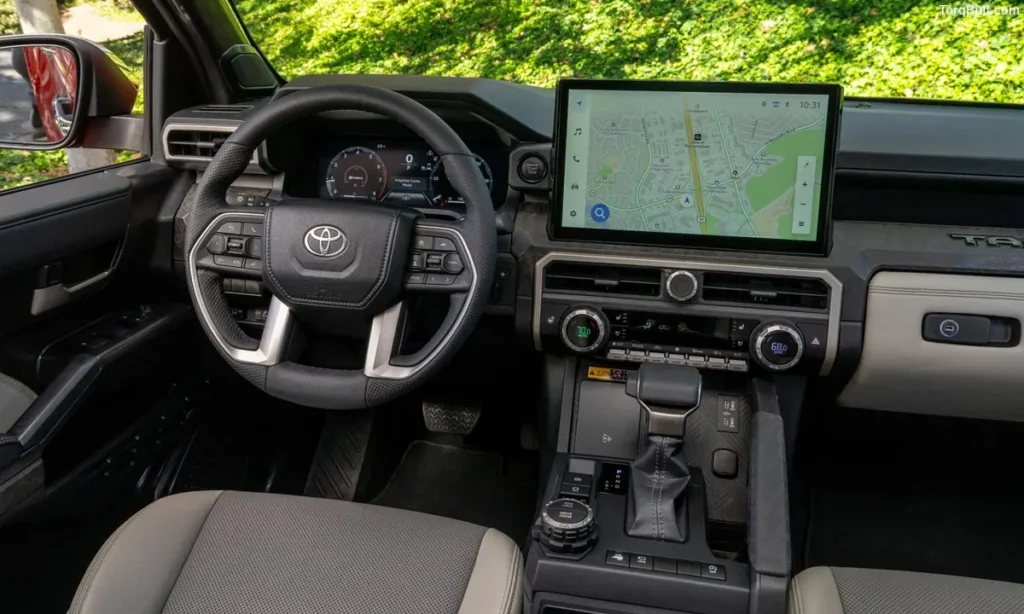
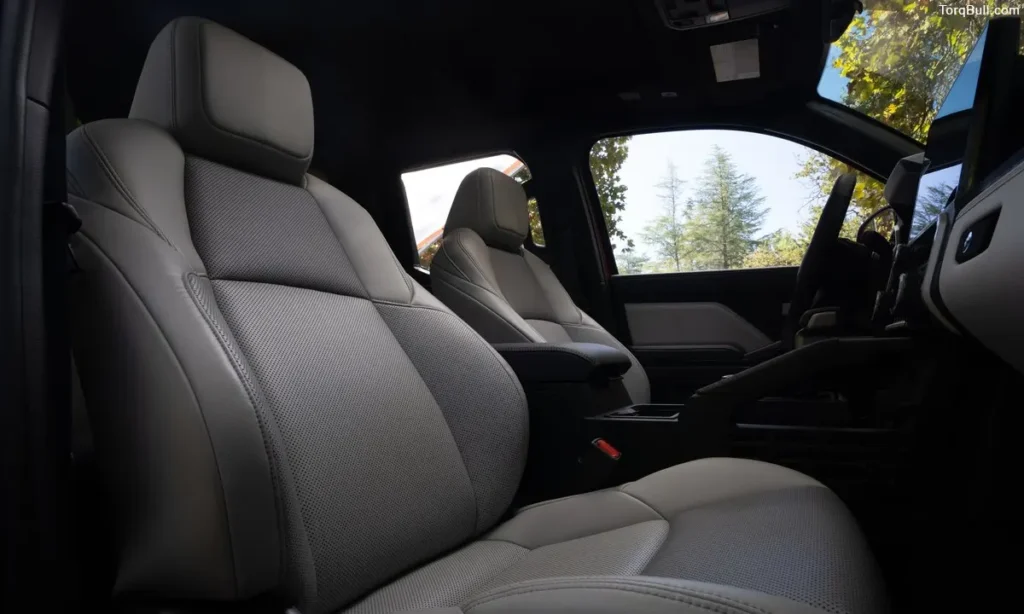
The Tacoma’s off-road suspension systems vary significantly across the trim lineup — and understanding these differences is essential for matching the right Tacoma specification to any specific off-road use case.
The TRD Off-Road trim’s Bilstein remote reservoir monotube shocks represent a meaningful upgrade over conventional twin-tube shock absorbers. Monotube designs place the oil and gas in a single tube with a floating piston separating them — producing more consistent damping under sustained off-road use by eliminating the oil foaming that occurs when twin-tube designs overheat during repeated compression cycles. The remote reservoir carries additional shock fluid, increasing the total thermal capacity and allowing the shocks to maintain consistent performance during extended trail sessions that would cause conventional shocks to fade. Toyota Bountiful’s analysis confirms the design’s specific advantage: the remote reservoirs house extra fluid to ensure shocks do not fade even during extended off-road use. The End Stop Control Valve technology increases damping force as the suspension approaches full compression — preventing harsh bottom-out impacts on the most severe trail obstacles.
The TRD Pro’s FOX QS3 internal bypass shocks with rear remote reservoirs represent a further level of sophistication. The three-position externally adjustable compression setting — selectable with a coin from outside the vehicle — allows the driver to tune the suspension character for the specific use case: Comfort for daily driving, Sport for moderate trail use and Firm for high-speed desert running and the most demanding terrain. GreenCars’ TRD Pro test confirms the practical effect: the IsoDynamic Performance seats with dampers absorbed the bumps and bangs that happened off-road — describing how the combined effect of superior shock hardware and the unique seat design reduced trail fatigue.
The Stabilizer Disconnect Mechanism — available on TRD Off-Road and standard on TRD Pro — is the most unique mechanical capability in the Tacoma’s off-road hardware suite. By electronically disconnecting the front stabilizer bar, the system removes the mechanical link that normally limits independent front suspension articulation — allowing each front wheel to travel independently through a significantly greater range of motion. Toyota’s official specification confirms this provides even greater confidence when traversing tough terrain. In practical terms, it allows the front tyres to maintain contact with uneven rock surfaces where the stabilizer bar’s connecting force would otherwise lift one tyre off the ground — the maximum articulation that makes the Tacoma’s front end uniquely capable on technical terrain compared to competitors without this feature.
The i-Force MAX Hybrid: How Instant Torque Changes Off-Road Dynamics
The i-Force MAX hybrid powertrain’s 465 pound-feet of torque is not primarily significant because it is more torque than the gas engine — it is significant because that torque is available instantly from zero RPM through the electric motor, before the turbocharger builds boost pressure.
Toyota Bountiful’s analysis captures the specific off-road advantage: the electric motor is invaluable for demanding off-road manoeuvres like technical rock crawling or navigating deep mud because it drastically improves throttle modulation — allowing precise control of wheel speed to maintain traction without excess revving or wheel spin. When a Tacoma with the gas engine is navigating a steep rock face in 4L with Crawl Control, the throttle input required to maintain momentum may produce a brief surge before the turbocharger achieves full boost — a subtle jolt that can break traction at the worst moment. The hybrid’s electric motor fills this boost-building gap with instant, precisely proportional torque that makes crawl speed management smoother than any gasoline-only alternative can achieve.
GreenCars confirms this from extended TRD Pro trail testing: the hybrid powertrain provides a smoother, more composed and immensely capable off-road experience — specifically crediting the low-end torque delivery as the transformative factor. The i-Force MAX is standard on TRD Pro and Trailhunter trims and optional on TRD Off-Road.
Toyota Tacoma Off-Road Systems by Trim — Complete Reference Chart
| Off-Road Feature | SR | SR5/TRD Sport | TRD Off-Road | TRD Pro | Trailhunter |
| 4WD (Part-Time) | Available | Available | Standard | Standard | Standard |
| 4WD (Full-Time) | No | No | No | No | No |
| Locking Rear Differential | No | No | Standard | Standard | Standard |
| Crawl Control | No | No | Standard | Standard | Standard |
| Multi-Terrain Select | No | No | Standard | Standard | Standard |
| Suspension Shocks | Standard | TRD Sport-tuned | Bilstein® Remote Reservoir | FOX® QS3 3-position | OME® Forged Monotube |
| Stabilizer Disconnect | No | No | Available | Standard | No |
| Multi-Terrain Monitor (cameras) | No | No | Available | Available | Available |
| i-Force MAX Hybrid Option | No | No | Available | Standard | Standard |
| High-Clearance Front Bumper | No | No | No | Standard | Standard |
| All-Terrain Tyres | No | No | Standard (33-inch on Pro) | 33-inch Goodyear® | 33-inch AT |
| Skid Plates | Front | Front | Front + Mid | Front + Mid + Rear | Front + Mid + Rear |
| IsoDynamic Performance Seats | No | No | No | Standard | No |
The Tacoma’s Off-Road Legacy and Competitive Position
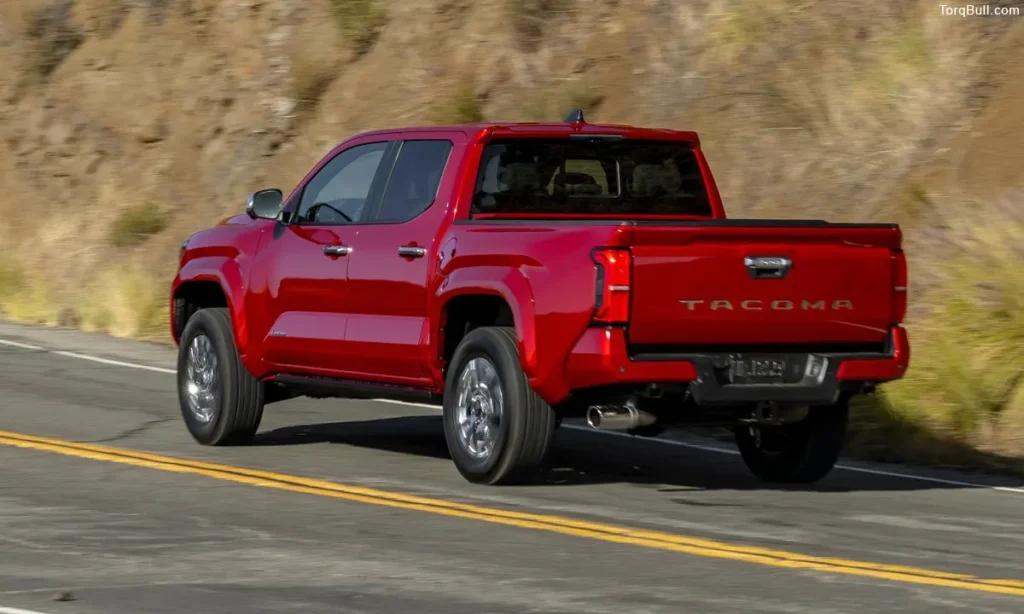
Edmunds’ 2026 full rating review positions the Tacoma between the top-ranked Ford Ranger and the more car-like Honda Ridgeline in the midsize truck segment — a competitive placement that reflects the Tacoma’s genuine off-road capability without overstating its overall segment leadership. The Ranger’s higher ranking reflects its more refined on-road character, while the Tacoma’s specific off-road hardware — Crawl Control, Multi-Terrain Select, the stabilizer disconnect and the upgrade path to FOX QS3 shocks — represent capabilities that the Ranger’s standard hardware does not replicate.
For buyers whose primary truck use includes regular off-road driving, the Tacoma’s off-road hardware ecosystem remains the most comprehensive factory-delivered package in the midsize segment. The TRD Off-Road — with Bilstein shocks, Crawl Control, Multi-Terrain Select and an available stabilizer disconnect — provides more off-road engineering per dollar than any directly comparable alternative. The TRD Pro — with FOX QS3 shocks, IsoDynamic seats and the i-Force MAX hybrid’s instant torque — represents the apex of factory midsize truck off-road capability.