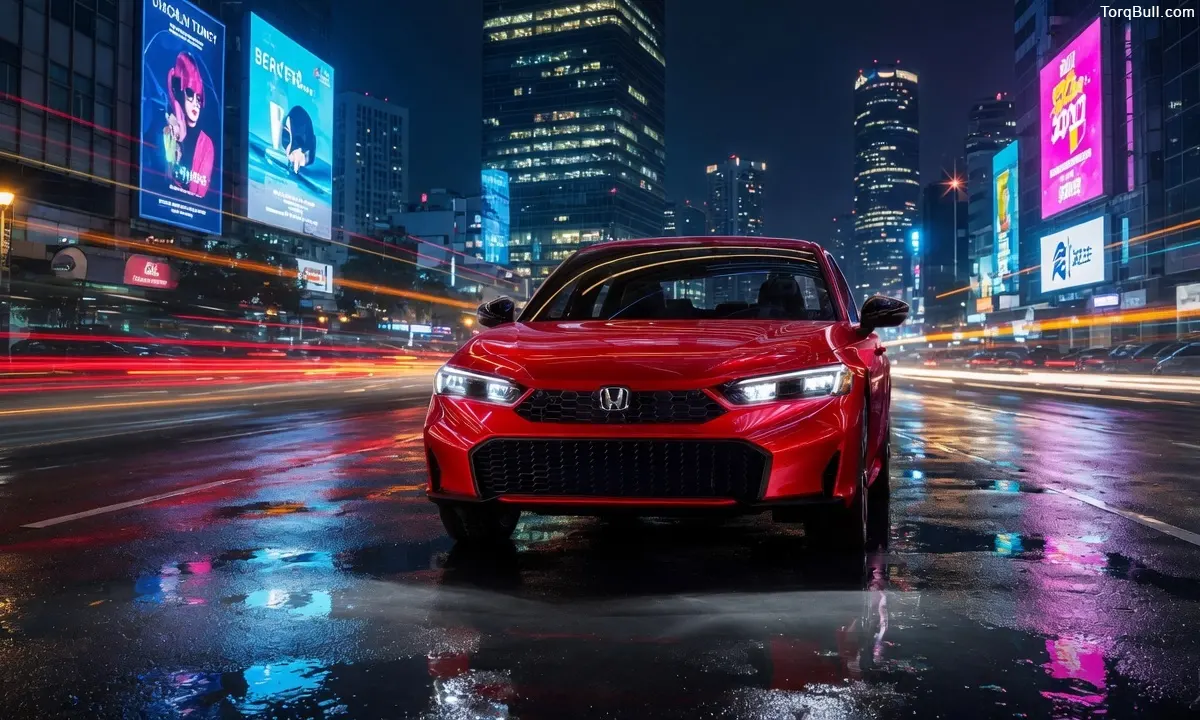
- The 2026 Honda Civic earns strong praise for its balanced performance, fuel efficiency and long-term dependability, with Autoblog calling it an easy recommendation and U.S. News awarding an 84 out of 100 predicted reliability score.
- Edmunds tested the Civic Hybrid from 0 to 60 mph in just 6.6 seconds while buyers are reportedly paying around 2 percent below MSRP, making the Civic one of the most refined and value-packed compact cars in its class.
- Despite its strengths, U.S. News notes the Civic starts at a noticeably higher price than rivals like the Toyota Corolla, Hyundai Elantra and Kia K4, which deliver similar practicality and features for considerably less money.
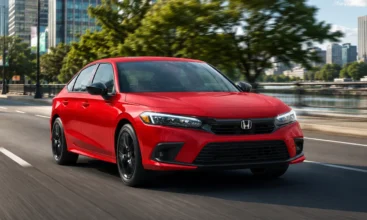
The Honda Civic is the best-selling compact sedan and hatchback in the United States — a position it has held for years based on a combination of genuine engineering quality, Honda’s documented reliability heritage and a driving character that consistently earns praise from both automotive media and the everyday commuters who depend on the car daily. The 2026 model carries forward the 2025 refresh with essentially no mechanical changes — Honda’s confidence in the current formula is high enough that no further updates were deemed necessary. Autoblog’s extended evaluation concludes that for buyers weighing whether the Civic is worth their time and money, the answer remains a resounding yes. JD Power’s expert reviewer describes the Sport trim as a compelling choice in the segment. And Edmunds confirms buyers are currently paying approximately 2 percent below MSRP, making the transaction more favourable than the sticker price alone suggests. But U.S. News delivers an important counterpoint: the Civic carries a higher starting price than rivals like the Corolla, Elantra and Kia K4, and those alternatives bring similar performance and interior space for considerably less. This guide provides the complete, balanced assessment every 2026 Civic buyer deserves.
What the 2026 Honda Civic Gets Genuinely Right
Fuel Economy That Leads the Segment
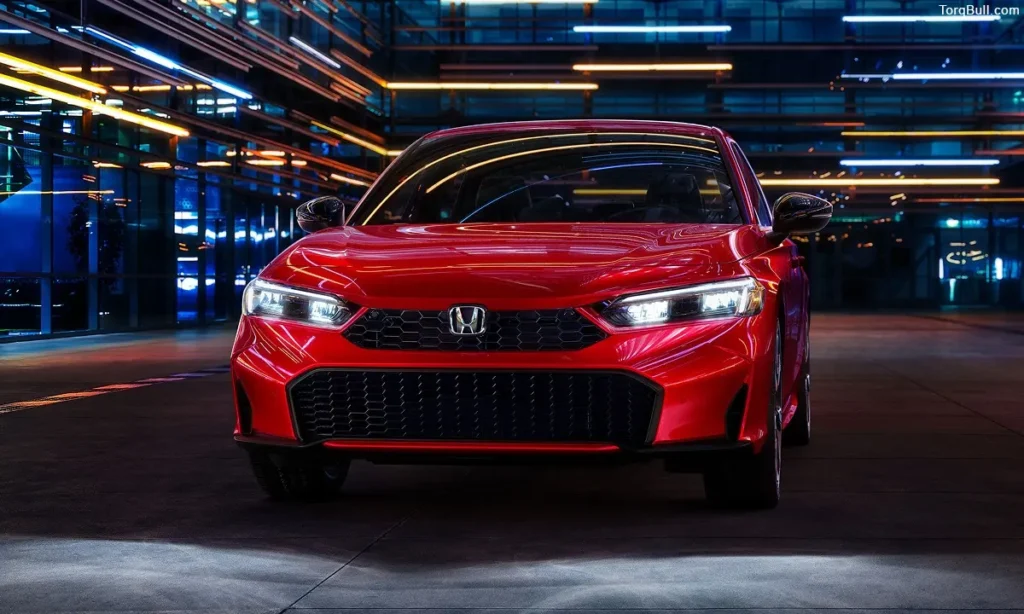
The 2026 Honda Civic’s most compelling buying argument is its fuel economy — particularly when the Hybrid powertrain is selected. The Sport Hybrid produces 200 combined horsepower from its two-motor hybrid system while achieving an EPA-estimated 49 MPG combined — a figure that is extraordinary for any non-plug-in vehicle in the compact segment and that dramatically outperforms the Civic’s most directly competing gasoline alternatives. Even the base 2.0-litre naturally aspirated engine in LX and Sport trims achieves 32 MPG city, 41 MPG highway and 36 MPG combined — results that lead the non-hybrid compact segment. One KBB owner who purchased the Civic Hybrid describes it simply: it is peppy, comfortable and gets 50 MPG. What’s not to like? For commuters whose annual fuel bill is a meaningful monthly expense, the Civic Hybrid’s fuel economy advantage over the Toyota Corolla Hybrid, Hyundai Elantra and Mazda 3 is a persistent, compounding financial benefit across the entire ownership period.
Reliability That Is Independently Validated
JD Power’s predicted reliability score for the 2026 Honda Civic is 84 out of 100 — a score that JD Power’s own scale describes as Great. RepairPal’s historical data across Civic model years places the vehicle third out of 36 compact cars with a 4.5 out of 5 rating and an average annual repair cost of approximately $368 — well below the compact segment average of $526. Multiple KBB reviewers specifically cite bulletproof Honda reliability as a primary purchase motivation, and at least one long-term owner describes a Civic ownership history stretching back 50 years. For buyers planning five to ten years of ownership, the Civic’s reliability record provides high statistical confidence in a low-surprise ownership experience.
A Hybrid Powertrain That Is Genuinely Enjoyable
Edmunds’ instrumented testing of the 2026 Civic Hybrid recorded a 0-60 MPH time of 6.6 seconds — significantly quicker than most other small sedans and other hybrids, and notably quicker than the sportier Civic Si’s standard 0-60 time. The Yahoo Autos extended review of the Sport Touring Hybrid confirms this performance character: the Hybrid drives efficiently while also making every drive as easy as possible, whether stuck in traffic, commuting on highways or navigating tight turns. The electric motor’s instant torque delivery at low speeds produces a responsiveness that the base engine’s 150 horsepower cannot replicate — transforming the Hybrid’s daily driving character from merely adequate to genuinely enjoyable. The reviewer specifically notes that the Hybrid’s powertrain setup turns fuel-efficient driving into an engaging activity rather than a discipline.
Standard Honda Sensing Safety Technology on Every Trim
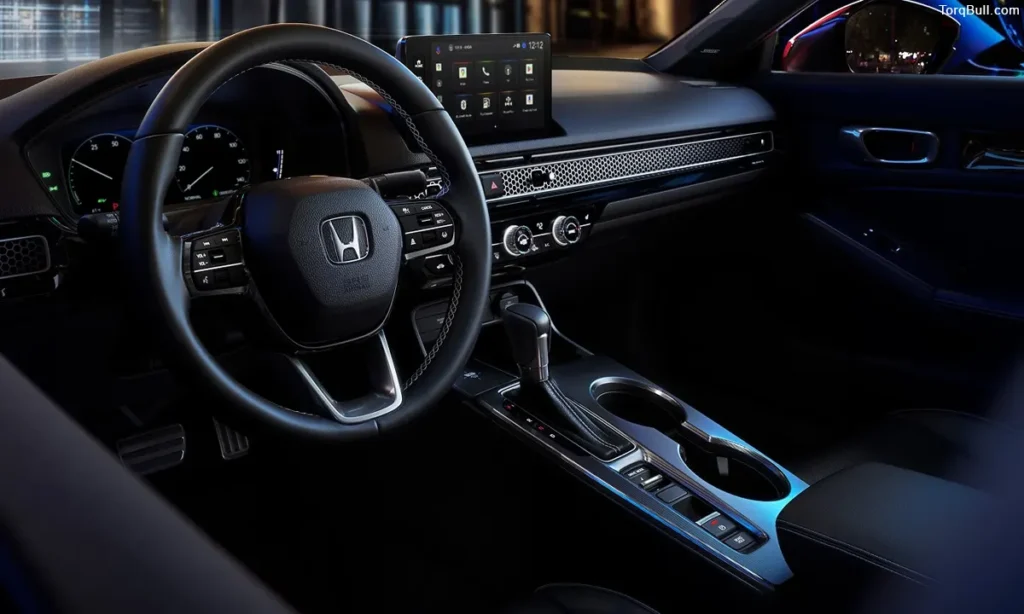
Every 2026 Honda Civic, from the base LX at $24,595 through the Sport Touring Hybrid at $32,295, includes Honda Sensing as standard equipment. This comprehensive driver assistance suite covers automatic emergency braking with pedestrian detection, lane keeping assist, adaptive cruise control with stop-and-go traffic management, road departure mitigation and traffic sign recognition. Receiving this full suite without requiring a safety technology package upgrade — as competing vehicles from Toyota and Hyundai provide in similar ways — means Civic buyers at every budget level receive the collision prevention technology that makes modern compact car ownership genuinely safer than previous generations. JD Power’s expert review confirms that Honda provides physical knobs for stereo volume and radio tuning alongside the digital interface — a specific design decision that allows common function adjustment without removing eyes from the road.
Interior Space That Beats Most Segment Competitors
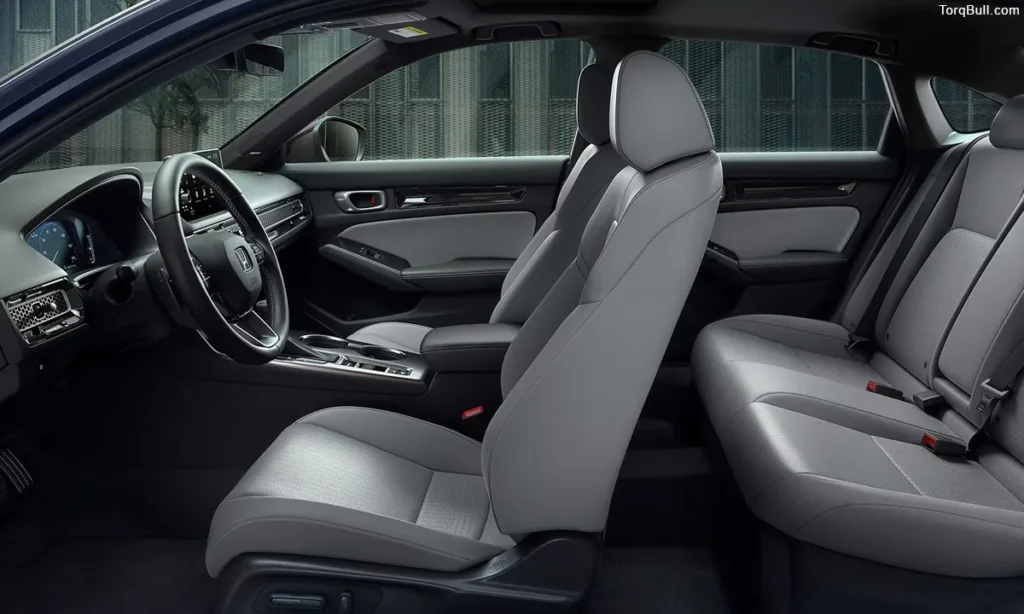
The 2026 Civic sedan provides 14.8 cubic feet of cargo space — more than the Mazda 3’s 13.2 cubic feet — and rear-seat legroom that leads most compact sedan competitors. Autoblog specifically identifies the Civic’s usable interior space and practical trunk as genuine family benefits. JD Power’s reviewer notes that for taller drivers, the Civic’s back seat can actually be more comfortable than the front — a counterintuitive observation that reflects the genuinely generous rear legroom the wheelbase provides. In hatchback form, the Civic’s cargo and passenger volume advantages over the Mazda 3 Hatchback are more pronounced still.
Read: Honda Civic vs Hyundai Elantra: Which Compact Sedan Is Actually Better in 2026?
Where the 2026 Honda Civic Falls Short
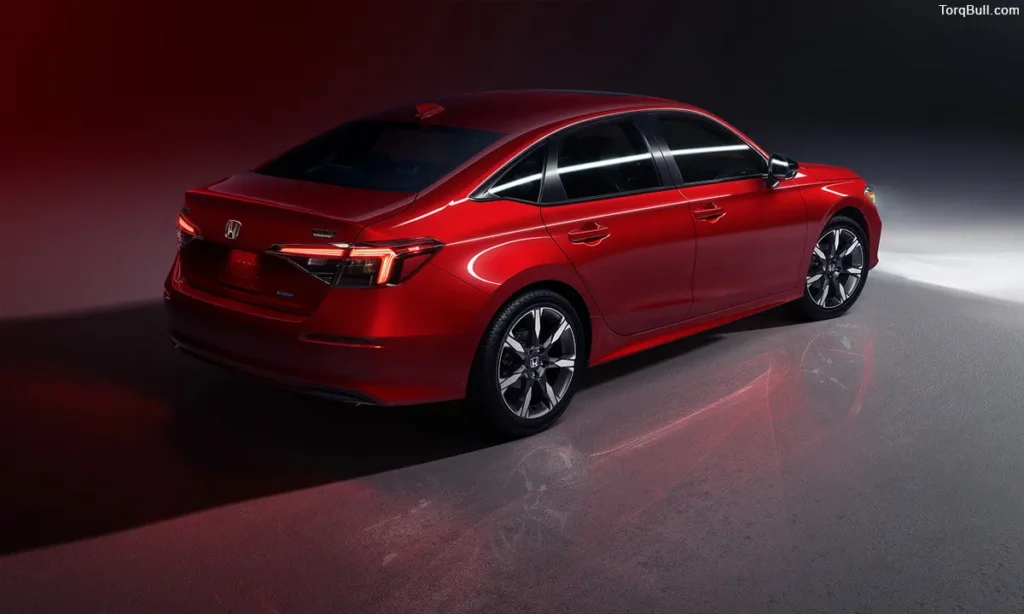
Higher Starting Price Than Key Competitors
U.S. News delivers the most important competitive pricing context: the Civic has a higher starting price than most of its competitors. At $24,595 for the base LX sedan, the Civic is more expensive than the Toyota Corolla LE at approximately $21,500, the Hyundai Elantra SE at approximately $22,000 and the Kia K4 at a similar entry price. For buyers comparing compact sedans on value per dollar at entry-level configurations, the Civic asks for a premium that competitors do not. U.S. News specifically names the Corolla, Elantra and Kia K4 as delivering similar performance, efficiency and interior space for considerably less money.
The Civic Hybrid’s premium versus competitors is even more pronounced. The Sport Hybrid starts at $29,295 — measurably above the Toyota Corolla Hybrid at $24,575 and the Hyundai Elantra Hybrid range. The Yahoo Autos hybrid reviewer specifically flags this pricing gap as a meaningful consideration for buyers who are comparison-shopping on hybrid fuel economy, where the Corolla Hybrid’s lower entry point with broadly comparable efficiency makes the Civic Hybrid’s premium harder to justify for budget-sensitive buyers.
Base Engine That Is Underpowered for Its Price
The base 2.0-litre four-cylinder engine producing 150 horsepower is the most consistently criticised Civic specification in professional and owner reviews. JD Power’s expert review states directly that passing on a two-lane road requires some planning, as does getting across a busy intersection. U.S. News confirms the base Civic is not going to win any races. KBB owner sentiment aggregated across 69 reviews identifies the underpowered engine as a genuine weakness, with one reviewer specifically describing an extremely boring CVT transmission. The CVT’s characteristic behaviour — where engine RPM climbs independently of vehicle speed during hard acceleration, producing a disconnected feel — is a specific criticism that appears across multiple KBB and Edmunds owner accounts.
For buyers who specifically want the base engine and CVT combination, the 150-horsepower output is adequate for typical daily driving. For buyers who want genuine performance engagement from a compact sedan, the base Civic is less compelling than the 200-horsepower Hybrid or the 200-horsepower Si at equivalent or slightly higher price points.
Collision Mitigation System Concerns
One significant and safety-relevant concern appears in multiple Edmunds owner reviews for 2025 and 2026 Civic Hybrid models: the Collision Mitigation Braking system triggering unexpectedly during highway driving. One Edmunds reviewer describes three braking interventions during a three-hour highway cruise control session where passing vehicles in adjacent lanes triggered the system — a false positive response that resulted in sudden deceleration at highway speed. The reviewer visited a dealer and was told the behaviour was normal. This is a serious safety concern rather than a minor inconvenience, and it represents a Honda Sensing calibration issue that prospective buyers should specifically investigate and test during a highway test drive before purchase.
Front Seat Comfort and Interior Material Limitations
JD Power’s extended review specifically identifies the front seats as a limitation — comfortable enough but lacking thigh support and, for taller people, insufficient seat-track travel. The reviewer also notes the wide centre console is finished in hard plastic unkind to legs resting against it. KBB sentiment aggregation identifies comfort as the Civic’s weakest consumer-rated attribute across its 69-review dataset. For buyers who cover long daily commutes or make regular road trips, the front seat ergonomics deserve specific evaluation on an extended test drive rather than a brief dealership loop.
Read: Is the Honda Civic Good for Long-Term Ownership? What It Costs and What The Risks Are In 2026
2026 Honda Civic — Worth It Assessment Chart
| Category | Rating | Evidence |
| Fuel economy (base) | Excellent | 36 MPG combined; leads non-hybrid compact segment |
| Fuel economy (Hybrid) | Exceptional | 49 MPG combined; Edmunds 6.6 sec 0-60 |
| Reliability prediction | Very Good | JD Power 84/100; RepairPal 4.5/5, 3rd of 36 compact cars |
| Standard safety technology | Excellent | Honda Sensing on every trim at no extra cost |
| Interior space (rear seat/cargo) | Very Good | Leads most compact sedan competitors |
| Starting price vs competitors | Below Average | Higher than Corolla, Elantra, Kia K4 at equivalent trims |
| Base engine power | Average | 150 hp; JD Power: “planning required” for passing |
| CVT transmission character | Below Average | Multiple owner accounts: boring, disconnected |
| Hybrid price vs competitors | Moderate | Sport Hybrid from $29,295 vs Corolla Hybrid from $24,575 |
| Collision mitigation accuracy | Concern | Multiple Edmunds owner false-positive highway reports |
| Front seat ergonomics | Average | JD Power: insufficient thigh support; short track travel |
| Resale value | Good | Historically above-average retention in compact segment |
| Dealer discount availability | Good | Edmunds: buyers paying ~2% below MSRP |
The Honest Verdict: Who the Civic Is Worth It For
The 2026 Honda Civic is worth buying for buyers who specifically prioritise fuel economy — particularly the Hybrid’s 49 MPG — Honda’s documented reliability record, comprehensive standard safety technology and the most interior space in the compact segment. For these buyers, Autoblog’s resounding yes verdict is well-supported. The Hybrid’s combination of 200 horsepower and near-50 MPG is unique in the segment and genuinely difficult to match.
It is a less compelling value proposition for buyers whose primary criterion is the lowest purchase price, where the Toyota Corolla, Hyundai Elantra and Kia K4 provide similar daily transportation at meaningfully lower starting prices. For buyers who experience the collision mitigation false-positive behaviour in highway driving, Honda’s current calibration is a genuine safety concern that deserves resolution before the vehicle can be recommended without qualification.
The Sweet Spot Recommendation: Edmunds identifies the Sport Hybrid as the best overall choice — pairing 200 horsepower with nearly 50 MPG without pushing buyers into the highest price bracket. The Sport Hybrid also offers the best dealer discount according to Edmunds’ data, at approximately $930 off MSRP on average. For buyers who can stretch to $29,295 and prioritise the combination of performance, fuel economy and Honda’s reliability legacy, the 2026 Civic Sport Hybrid is one of the most defensible compact car purchases available in the American market.