Let me start with the good news, because there’s a lot of it. In 2026, buying a used EV might be one of the smartest moves in the entire car market. The first big wave of leased electric cars is returning to dealer lots, prices have dropped 35 to 50 percent from new, and you can snag a higher-end model for the price of a basic one. And the batteries? They’re holding up far better than the doom-mongers predicted, with most packs retaining around 90 percent of their capacity even after high mileage.
But here’s the catch that trips up so many buyers. On an EV, the stakes are different than with a gas car. A tired engine is annoying; a tired battery can be a five-figure mistake. Your job is to separate the roughly 90 percent of solid cars from the 10 percent that can wreck your budget, and the danger is that your instincts from decades of buying gas cars, check the mileage, listen to the engine, look for oil leaks, completely miss the EV-specific killers.
So let me walk you through the three costly red flags most buyers miss, the ones hiding in plain sight that can save you thousands and a lot of regret. Quick note, repair estimates vary and this is general guidance, not personalized advice, so get an independent inspection on anything pricey.
Red Flag #1: An Unverified Battery (The Odometer Lies)
This is the big one, and it’s the one buyers miss most, because they’re trained to trust the odometer. On a gas car, mileage tells you most of what you need to know about wear. On an EV, the odometer tells you very little by itself. A three-year-old EV with 60,000 miles and a healthy battery can be in better shape than the same car with 30,000 miles and a tired one, depending entirely on how it was charged and stored.
The number that actually matters is battery State of Health, or SoH, the percentage of original capacity the pack still holds, and it’s invisible unless you pull it. Here’s why missing it is so costly: the difference between a battery at 92 percent SoH and one at 75 percent can mean 30 to 40 percent less real-world range and up to a $6,000 swing in fair market value, and a genuinely degraded pack can cost $8,000 to $22,000 to replace. That’s not a repair, that’s a catastrophe.
The sneaky trap is that a mildly tired battery still looks fine on the dashboard. Buyers overpay for cars at 80 to 84 percent SoH because the dash still shows a comfortable range in ideal conditions, while winter and highway driving expose the real deficit. So price for the cold worst-case range, not the optimistic number on the screen.
How do you check? Modern EVs are surprisingly talkative. Tesla, Ford, GM, Hyundai, and Kia expose battery data in the owner app, so ask the seller to log in and show you. Better yet, use a Bluetooth OBD-II dongle with a model-specific app like LeafSpy or Car Scanner, or pay a few hundred dollars for an independent EV battery inspection. The rule of thumb: anything above 88 to 90 percent SoH at 100,000 miles is healthy, while SoH below 80 percent early in the car’s life is a walk-away unless the price reflects it. If the seller can’t or won’t provide a battery report, that’s your first red flag right there.
Red Flag #2: Abusive Charging and Climate History
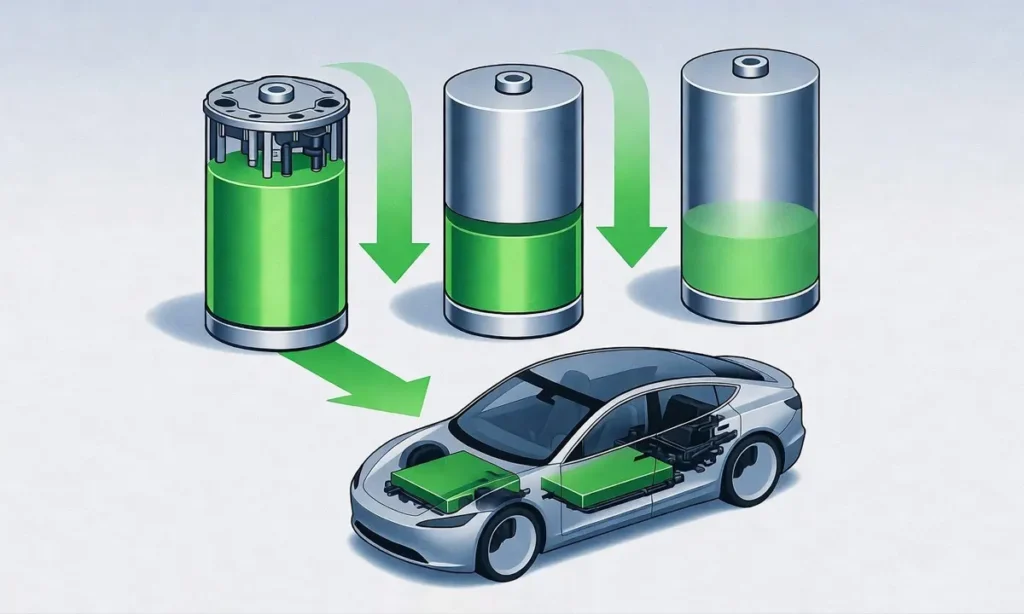
Here’s a red flag that’s completely invisible on a spec sheet, which is exactly why buyers miss it: how the car was charged, and where it lived. Two identical-looking EVs with the same mileage can age dramatically differently based on these hidden variables.
The charging story matters enormously. A vehicle charged regularly at moderate power tends to age better than one charged almost exclusively at high-power fast chargers. A car that spent its life slamming electrons in at DC fast chargers has been under far more thermal stress than one topped up gently at home overnight. So ask directly: was this a home-charged car, or a fast-charge-heavy one?
Climate is the other silent killer, and it’s brutal on the wrong cars. Early Nissan Leafs used air-cooled batteries with no active thermal management, and in hot climates like Arizona, Texas, and Florida, some lost 30 percent of capacity in just three years. The lesson is blunt: be extremely cautious with air-cooled or passively-cooled EVs unless the car lived somewhere cold. Even on liquid-cooled cars, a life in extreme heat without service records is a yellow flag worth investigating.
If you can pull deeper diagnostics, watch for two specific warning signs: a large cell imbalance, meaning more than 80 to 100 millivolts of difference between modules, and repeated thermal-limiting events recorded in the log, which signal a pack that’s been overheating. Both suggest a battery that’s been abused, and neither shows up when you kick the tires.
Red Flag #3: Recalls, Software Gremlins, and Underbody Damage
The third miss is really a cluster of EV-specific problems that traditional inspections skip entirely. First, recalls. Some EVs carry well-documented high-voltage battery recalls or fire-risk campaigns, with the Chevy Bolt and Hyundai Kona Electric among the most discussed. Many have been fixed, but you must verify recall completion and battery-replacement paperwork. Here’s the counterintuitive good news: a recalled-and-repaired EV, especially one that got a fresh battery, can actually be a better buy than an untouched example. The red flag is an open recall the seller won’t address before the sale.
Second, software and electronics. This surprises people, because modern EV complaints center on infotainment failures, charging glitches, and failed over-the-air updates rather than motors or hardware. First-generation EV platforms often need multiple software cycles before their bugs get ironed out, and a flaky charging interface will annoy you several times a week. So during your test drive, actually use the screen, the charging menu, and the connectivity, not just the accelerator.
Third, and this one is almost never checked: look under the car. Get down and inspect for fresh scrapes, dents in the battery enclosure, missing underbody panels, or homemade shielding. Battery-pack damage or floorpan repairs are costly and dangerous, and buyers miss them because nobody thinks to look beneath an EV. And if any battery, high-voltage, or thermal warning light appears on the dash during your drive, treat it as a giant red flag and walk away unless a qualified EV tech can document a fix.
Read: What It Really Costs to Own an EV in The US (Hidden Fees Inside)
The Three Red Flags at a Glance
Here’s your quick-reference cheat sheet.
| Red Flag | Why Buyers Miss It | Walk-Away Trigger |
| Unverified battery SoH | They trust the odometer | SoH under 80% early, or no report |
| Abusive charging/climate | Invisible on a spec sheet | DC-only + hot-climate air-cooled pack |
| Recalls / software / underbody damage | Not on a gas-car checklist | Open recall unaddressed, battery warning light, enclosure damage |
The Bonus Flag: The Evasive Seller
One more, because it ties everything together. Watch the person selling the car. The seller who can’t explain why the previous owner sold, evades battery or charging questions, or changes their story on accidents and recalls is waving a flag. So is the one who won’t let you take the car for an independent inspection, won’t allow a battery test, or insists on meeting at odd locations. Inconsistency is a data point. If someone makes it hard to verify basic facts, assume the facts aren’t in their favor. A “today only” price dramatically below market with a rushed backstory is a classic trap. A legitimate seller may set reasonable boundaries, but they won’t fight you on verification.
Verdict: A Sorting Exercise, Not a Minefield
So are used EVs a reliability nightmare? Absolutely not, and I want to be clear about that. Used EVs are not a minefield, they’re a sorting exercise. Most of the cars you’ll see are perfectly decent machines that just need a reasonable inspection and an honest price, and 2026’s flood of affordable lease returns makes this a genuinely great time to buy. The horror stories you read online are the outliers, they’re just the ones you want to avoid.
The key is understanding that a used EV is a different animal to inspect. Your gas-car instincts, the ones that served you well for decades, will sail right past the three problems that actually matter. So retrain them. First, never trust the odometer alone, pull the battery State of Health number and price for the real, cold-weather range. Second, dig into how the car was charged and where it lived, because a low-mileage car with a fast-charged, sun-baked battery can be worse than a high-mileage one that was babied. Third, verify the recalls, actually test the software, and get down and look under the car for battery damage.
Do those three checks, plus a healthy read on whether the seller is transparent, and you flip the entire equation. Thirty minutes and maybe a few hundred dollars for an independent battery report can save you a $10,000 mistake, turning a nerve-wracking gamble into a confident bargain. Sort the cars into green, yellow, and red piles: green if the battery is documented and healthy, the title is clean, and warranty remains; yellow if a few questions need answers before you commit; red if the seller dodges verification, warning lights are on, or an open recall lingers.
The best value in 2026 is a three-to-four-year-old EV sitting at 88 to 92 percent State of Health, letting someone else eat the steep early depreciation while you enjoy 8 to 10 years of useful life for thousands less than new. Those cars are out there right now, in real numbers. You just have to know which three red flags separate them from someone else’s expensive experiment. Now you do. Go find your bargain, pull that battery report, and buy with your eyes wide open. The deal of the decade might be sitting on a dealer lot near you, and it won’t cost you a fortune, as long as you don’t miss the flags everyone else does.