After decades of filling a gas tank in three minutes flat, the idea of “charging time” feels mysterious and vaguely stressful. How long will I be stuck at the plug? An hour? Overnight? A week? The uncertainty is enough to scare people off EVs entirely.
Here’s the good news: the math behind charging time is genuinely simple, and once you know the trick, you can estimate any EV on any charger in about ten seconds of mental arithmetic. No engineering degree required. The core formula fits on a sticky note, and a few common-sense tweaks handle the real-world messiness.
So let me hand you the simple trick to calculate EV charging time, walk through a couple of real examples, and then give you the three adjustments that separate a napkin guess from an accurate estimate. By the end, the mystery will be gone for good.
The One Formula You Actually Need
Here’s the whole trick, the thing to write on that sticky note. An EV’s charging time depends on two factors: how much energy you need to add, measured in kilowatt-hours, and how much power the charger provides, measured in kilowatts. Divide the first by the second, and you get your time.
Charging time (hours) = Energy needed (kWh) ÷ Charger power (kW)
That’s it. The only extra step is figuring out the energy needed, which is just your battery size times the percentage you want to add. If you have a 60 kWh battery and you want to go from 20 percent to 80 percent, that’s 60 percent of the battery, or 36 kWh. Plug that into a 10 kW home charger and you get 36 ÷ 10 = 3.6 hours. Done. You just calculated a charging time in your head.
Think of the battery capacity in kilowatt-hours as the size of your fuel tank, and the charger’s kilowatts as how fast the pump flows. Bigger tank, longer fill. Faster pump, quicker fill. It really is that intuitive once you stop being scared of the units.
Two Quick Worked Examples
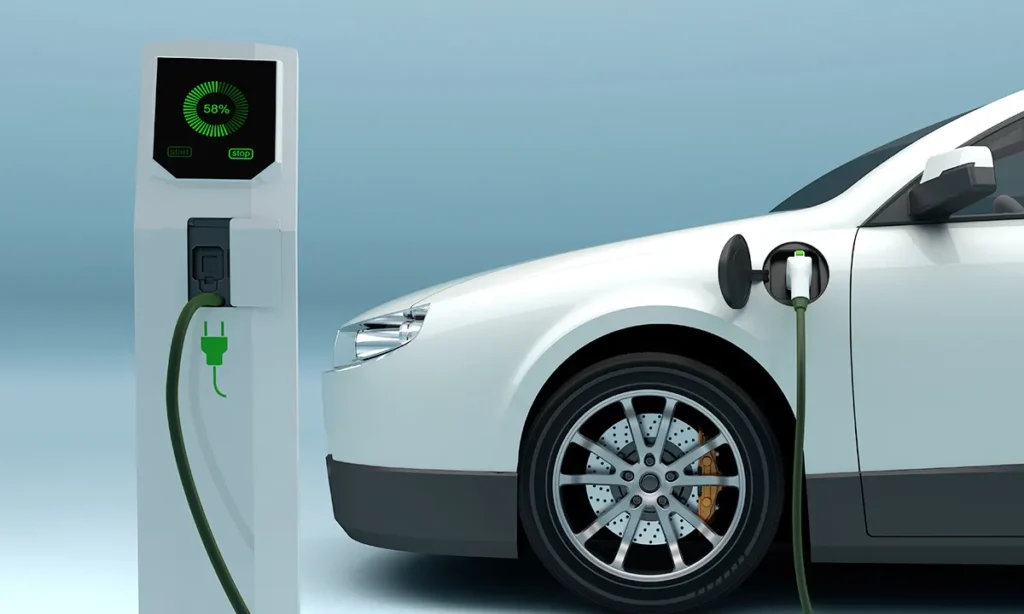
Let’s cement it with real cars. Take a Tesla Model 3 with an 80 kWh battery parked at a typical 7.68 kW Level 2 home charger, sitting at 20 percent and wanting 80 percent. First the energy: 80 kWh times 60 percent equals 48 kWh needed. Then the time: 48 divided by 7.68 equals about 6.25 hours. A perfect overnight charge.
Now watch how dramatically the charger changes things. A 75 kWh battery going from 10 percent to 80 percent needs about 52 kWh. On an 11 kW Level 2 charger, that’s roughly 5.3 hours. Plug that exact same car into a 150 kW DC fast charger, and the same charge takes about 19 minutes. Same battery, same energy, wildly different time, all because the pump got 14 times faster. That single comparison explains why home charging is an overnight thing and road-trip charging is a coffee-break thing.
The Three Adjustments That Make It Real
The sticky-note formula gets you 90 percent of the way there. To nail the real-world number, apply three quick adjustments, and these are the ones most people miss.
First, and most important: use the lower of the two power numbers. Your charging speed is limited by either the charger or your car, whichever is slower. A vehicle capped at 50 kW DC will only pull 50 kW even on a mighty 350 kW station, and a car with an 11 kW onboard charger won’t exceed 11 kW on any home unit no matter how beefy. So always check both your car’s maximum acceptance rate and the charger’s output, then calculate with the smaller number. This is the single biggest mistake people make.
Second, add about 10 percent for efficiency losses. Some energy is lost to heat and conversion, so the real formula multiplies the charger power by roughly 0.9, or equivalently divides your time estimate’s result to pad it slightly. In plain terms, if the math says 5 hours, expect closer to 5.5. Not a huge deal, but it keeps you honest.
Third, and this is crucial for road trips: only calculate DC fast charging up to 80 percent. Charging isn’t linear. From 0 to 80 percent, power stays high, but above 80 percent the battery management system slashes the power to protect the cells, so the last 20 percent can take as long as the first 80. That’s exactly why manufacturers always quote fast-charging times as “10 to 80 percent.” On a highway stop, charge to 80 and go. Waiting for 100 percent at a fast charger is a rookie mistake that wastes huge amounts of time.
Read: Used EV Reliability: 3 Costly Red Flags Most Buyers Miss
The Charging Levels at a Glance
Here’s how the three charging levels translate the formula into real life.
| Level | Typical Power | 10 to 80% Time | Range Added/Hour | Best For |
| Level 1 (120V) | 1.2 to 1.4 kW | 35 to 45 hrs (full) | 3 to 5 miles | Light daily topping up |
| Level 2 (240V home) | 7 to 11 kW | 4 to 8 hrs | 25 to 30 miles | Overnight home charging |
| Level 3 (DC fast) | 50 to 350+ kW | 20 to 40 min | Hundreds | Road trips |
The takeaway is that each level serves a purpose. Level 1 off a standard wall outlet is painfully slow and only practical for short commutes. Level 2 is the daily driver’s sweet spot, filling most cars overnight and adding 25 to 30 miles per hour. And DC fast charging is your road-trip tool, cramming most of a charge back in the time it takes to grab a sandwich.
The Other Factors Worth Knowing
A few real-world variables can nudge your estimate, so keep them in mind. Cold weather is the big one: freezing temperatures increase internal resistance and slow the chemistry, so charging can take 20 to 40 percent longer, though many EVs preheat the battery automatically when you navigate to a charger. State of charge matters too, since speed drops noticeably above 50 to 60 percent and plummets past 80. And at busy public stations, power sharing can split the available electricity among several cars, slowing everyone down. None of these break the formula, they just remind you to treat your estimate as a solid ballpark rather than a stopwatch guarantee.
The Reframe: Why “Time to Full” Barely Matters
Here’s the mindset shift that makes all of this less stressful. A bigger battery does take longer to fill at the same power, simply because there’s more to top off. But bigger batteries usually pair with faster acceptance rates and give you more range, so you charge less often in the first place. It roughly evens out.
More importantly, you almost never charge from empty to full in daily life. The average American drives about 37 miles a day, which uses only 10 to 13 kWh, or about 1 to 2 hours of Level 2 charging. So the real daily routine isn’t a marathon fill-up, it’s a small overnight top-up. You plug in when you get home, you unplug in the morning, and the car is full. The “how long to charge” anxiety that scares people off EVs mostly evaporates the moment you have a home charger, because you’re never actually waiting, you’re sleeping.
Verdict: One Formula, Total Confidence
So let’s put a bow on the simple trick. To calculate any EV’s charging time, take the energy you need to add, which is your battery size times the percentage you’re adding, and divide it by the charger’s power in kilowatts. Energy needed divided by power equals hours. That sticky-note formula alone gets you a genuinely useful estimate for any car and any plug.
Then sharpen it with the three adjustments that matter: always calculate using the lower of your car’s and the charger’s power ratings, pad the result by about 10 percent for efficiency losses, and never calculate DC fast charging beyond 80 percent because the curve tapers hard after that. Master those, factor in cold weather when it applies, and you’ll estimate charging times like a seasoned EV owner.
Here’s when the math actually matters and when it doesn’t. On a road trip, the formula is genuinely useful, helping you plan how long each DC fast stop will take so you can time it around a meal or a break. But for everyday driving, you barely need it at all, because you’ll simply plug in overnight on Level 2 and wake up to a full battery, having “waited” zero minutes. That’s the beautiful secret of EV ownership that the charging-time question obscures: once you’re set up at home, the plug becomes an afterthought.
So keep the sticky-note formula in your back pocket for road trips, ignore it the rest of the time, and stop letting charging-time anxiety keep you from an EV. The math is simple, the daily reality is even simpler, and now you know the trick to calculate it all. Divide the kilowatt-hours by the kilowatts, and you’ve got your answer. Go charge with confidence.