- Highland Model 3 gets upgraded suspension components
- Frequency-selective dampers improve ride comfort
- New bushings and springs enhance stability
- Acoustic glass reduces cabin noise significantly
- Ride quality vastly improved over previous generation
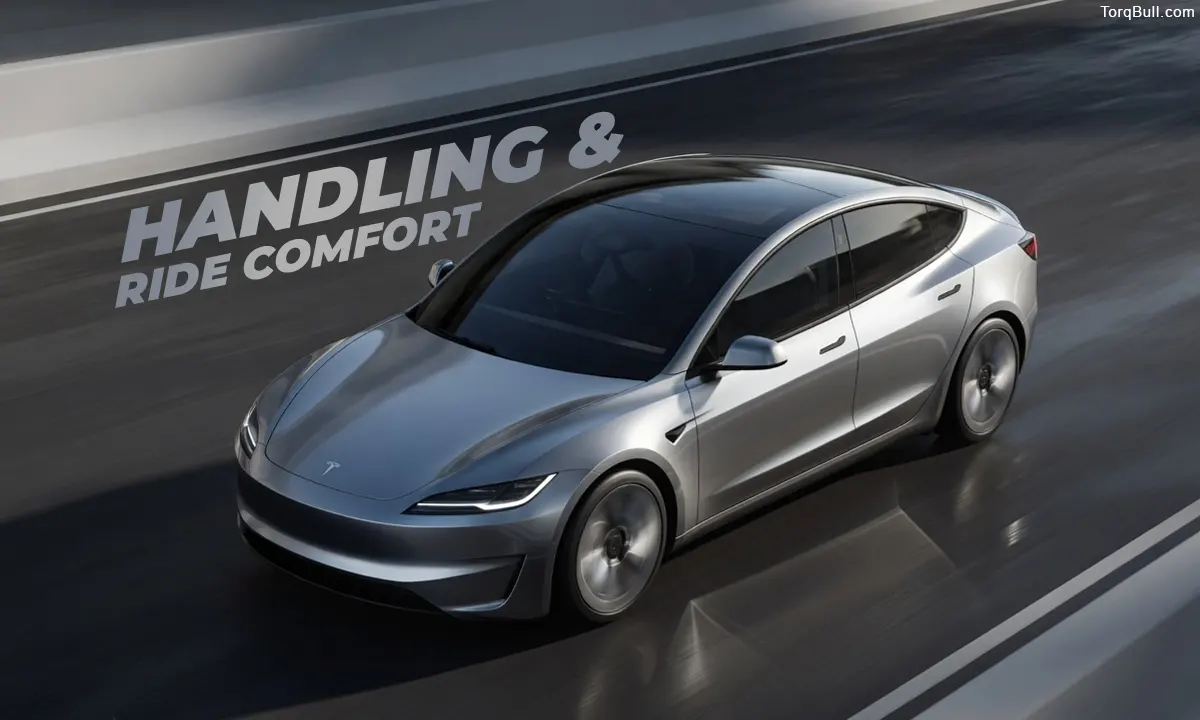
Tesla Model 3 Handling and Ride Comfort: The Tesla Model 3’s handling and ride comfort story is fundamentally a before-and-after story — divided precisely at the 2024 Highland refresh that addressed what was, from 2017 through 2023, the most consistently documented criticism of an otherwise excellent vehicle. The pre-refresh Model 3 was widely praised for its performance, range and software but equally widely criticised for a suspension tune that prioritised cornering stiffness over everyday comfort, producing a ride that automotive media and owner reviews consistently described as too firm for a daily driver, particularly on larger wheels. The Highland refresh changed this — comprehensively and measurably — through a combination of hardware and noise-isolation improvements that transformed the vehicle’s character while preserving the sports sedan handling dynamics that defined its original appeal. This review assesses both the Highland generation’s handling and ride comfort in detail, explains the specific engineering changes that produced the improvement and calibrates expectations for the Performance trim’s adaptive suspension system.
The Pre-Highland Baseline: Why Ride Comfort Was the Model 3’s Biggest Weakness
Understanding how good the Highland-generation Model 3’s ride quality is requires briefly establishing what the pre-refresh car delivered — because the improvement is only fully appreciated in context. From 2017 through the 2023 model year, the Tesla Model 3’s suspension tuning prioritised handling over comfort in a way that made the vehicle less pleasant to live with daily than many buyers expected from a sedan positioned above mainstream competitors.
The pre-refresh Model 3 used conventional passive dampers with spring rates calibrated for cornering stability and low body roll rather than bump absorption. On smooth, well-maintained roads, this tuning produced a crisp, connected driving feel that enthusiasts genuinely appreciated — the car communicated road surface information through the steering and chassis with a clarity and directness that set it apart from the more isolated character of most mainstream EVs. On rough or imperfect surfaces — the cracked asphalt, pothole-damaged roads and undulating motorway surfaces that characterise most American road infrastructure — the same tuning transmitted vibration and impact force into the cabin with a directness that many owners described as tiring on long journeys.
The inside of a pre-refresh Model 3 at highway speed on a degraded surface registered cabin noise levels noticeably higher than comparably priced German alternatives, with wind noise and tyre roar more prominent than a $42,000 vehicle’s positioning warranted. This pre-refresh ride and noise character was the source of the highest volume of owner complaints across the vehicle’s first six years of production — and it was the problem the Highland refresh was most specifically engineered to solve.
Read: Total Cost of Owning a Tesla Model 3 In USA. Analysis That Every Buyer Needs Before Signing
The Highland Suspension Engineering: What Changed and Why It Works
The Tesla Model 3 Highland refresh addressed ride quality through a systematic package of suspension and noise-isolation changes that acted together rather than in isolation — which is why the improvement is as dramatic as the owner community reports, rather than merely incremental.
The most significant mechanical change is the introduction of frequency-selective dampers — also called dual-rate or progressive-rate dampers — as standard equipment on the non-Performance Long Range and Premium variants. Unlike conventional single-rate passive dampers that provide a fixed resistance regardless of the frequency and amplitude of input, frequency-selective dampers can passively adjust their rebound rate based on the nature of the road input. At high frequencies — the rapid, small inputs from rough road textures and surface irregularities — the dampers respond with reduced resistance, allowing the wheel to move more freely and absorbing the energy before it reaches the body. At lower frequencies — the slower, larger inputs from bumps, road joints and undulations — the dampers provide more resistance, controlling body motion and maintaining the flat cornering composure that defines the Model 3’s handling character.
The practical effect, as InsideEVs’ 2024 review describes it, is that the car “softens its suspension” over washboard-type surfaces and small imperfections — the dampers feel like they are working actively, which they are, despite being passive in their operation. Munro and Associates’ hands-on testing on their private test track confirmed an “immediately noticeable difference in suspension feel” over washboard sections, with “no perceptible steering vibration” compared to the prior-generation car, which transmitted jitter through the wheel on the same surfaces.
Complementing the new dampers, Tesla revised the suspension bushings throughout the Highland chassis — components that connect the suspension arms to the subframe and body and that determine how much of the road’s impact force reaches the passenger compartment. Stiffer bushings transmit more road information but also more harshness; softer, more compliant bushings isolate the body from road shock more effectively. The Highland’s new bushings are calibrated specifically to work with the frequency-selective dampers, allowing greater suspension articulation over sharp inputs while maintaining the roll stiffness needed for flat cornering.
The noise isolation improvements compound the suspension benefits. Acoustic laminated glass on all four doors — a first for the Model 3 — reduces high-frequency wind and road noise by a measurable margin compared to standard glass. EV Help Hub’s long-term review recorded 67 dB cabin noise at approximately 70 mph with a headwind — a figure that the reviewer described as among the quietest interiors experienced in any vehicle at any price. The Autopro Nashville guide confirms that cabin refinement is one of the Highland generation’s most consistently praised attributes among 2024 and 2025 owners.
Handling Character: Sports Sedan Dynamics Preserved, Refined
The ride quality improvement would be less impressive if it came at the cost of the Model 3’s handling character — but the Highland refresh specifically avoided that trade-off. The frequency-selective dampers’ ability to provide both comfort over small inputs and body control over cornering loads means that the steering response, cornering composure and general sports sedan character that made the pre-refresh Model 3 enjoyable to drive have been preserved rather than softened away.
InsideEVs’ test driver noted that the new Model 3 still “feels sporty, but not as sporty as before” — a characterisation that captures the trade-off accurately. The softer bump absorption comes with a slightly more relaxed cornering character than the pre-refresh car at the limit — the body leans very slightly more through fast corners, and the steering is fractionally less sharp in its immediate response to quick directional changes. This is a trade-off that the overwhelming majority of owners — who spend most of their time in urban and suburban traffic rather than at the cornering limit — evaluate as clearly positive.
The steering itself is a consistent highlight in professional and owner reviews of all Model 3 generations. InsideEVs specifically identifies it as “one of the highlights of the Model 3 driving experience” — direct, well-weighted and communicative in a way that separates the car from the over-assisted, numb steering common to most EVs. The Highland’s steering tuning preserves this character while adding a slightly more settled and less nervous quality at motorway speeds than the pre-refresh car demonstrated.
Read: Tesla Model 3 Charging Cost Per Mile In USA. Complete 2026 Cost Analysis
The Performance Trim’s Adaptive Suspension: A Different Experience
The Model 3 Performance is specified with a qualitatively different suspension system from the standard and Long Range trims — active electronically controlled adaptive dampers that adjust in real time based on driving mode selection and road conditions.
Performance owner accounts in the Tesla Motors Club community describe the adaptive suspension’s Standard mode as “gliding over roads like a cloud” — the system’s softened standard setting absorbs road inputs more generously than even the Highland Long Range’s frequency-selective dampers. Switching to Sport mode produces a palpable and immediate stiffening: one owner describes the transition as physically feeling the car “tensing up,” with increased road feedback, reduced body lean and the heightened chassis connection that defines a performance driving experience. The contrast between modes is described as making it feel “like two cars in one” — a compliment that captures the adaptive system’s effectiveness at serving both comfort and performance priorities from a single platform.
The Performance also rides approximately 10 millimetres lower than other Model 3 variants, which improves aerodynamics and reduces centre of gravity for cornering purposes but creates a ground clearance limitation that owners note can cause the front lip or mudflaps to contact aggressive speed bumps and steep drive transitions. This is a known and documented characteristic of the Performance rather than an individual manufacturing variation.
Ride Comfort by Wheel Size: The Tyre’s Dominant Role
One of the most practically useful insights from the Highland-generation Model 3 review community is the significant role wheel and tyre specification plays in daily ride quality — a factor more impactful than the suspension tune itself under typical road conditions.
The standard 18-inch Photon alloy wheel with its associated tyre sidewall depth — providing substantially more pneumatic cushioning than larger wheels — delivers the most compliant, most comfortable everyday ride quality of any Model 3 configuration. InsideEVs specifically notes that the Highland’s ride quality is “vastly improved, even on the larger 19-inch wheels” — confirming that the improvement is genuine across all wheel sizes, while implicitly confirming that the 18-inch specification is preferable for pure ride comfort.
The 19-inch Sport wheels — available on Premium and Long Range trims — produce a noticeable but not dramatic increase in the transmission of sharp road impacts compared to the 18-inch wheels. The reduced tyre sidewall provides less cushioning over road joints and potholes. Most owners who select 19-inch wheels do so for the visual appearance advantage and accept the modest comfort trade-off as reasonable. The 20-inch Performance wheels on the Performance trim, with the widest footprint and lowest sidewall, transmit the most road information — and the adaptive suspension’s Standard mode specifically compensates for this by operating at a notably softer setting than equivalent standard-trim cars.
Read: Tesla Model 3 Hidden Features You Should Know. 12 Hidden Features Will Surprise You
Tesla Model 3 Handling and Ride Comfort — Complete Assessment Chart
| Model / Trim | Suspension Type | Wheel Size | Ride Comfort | Handling | Cabin Noise | Best Suited To |
| Standard RWD (18″) | Passive (freq-selective) | 18-inch Photon | Excellent | Good | Very low | Urban + daily comfort |
| Standard RWD (19″) | Passive (freq-selective) | 19-inch Sport | Very good | Good | Low | Mixed daily / style |
| Premium RWD (18″) | Passive (freq-selective) | 18-inch Photon | Excellent | Good–Very good | Very low | Long range + comfort |
| Premium AWD (18″) | Passive (freq-selective) | 18-inch Photon | Excellent | Very good | Very low | All-weather comfort |
| Performance AWD (Standard mode) | Adaptive active (adjustable) | 20-inch Warp | Very good | Excellent | Low | GT comfort + performance |
| Performance AWD (Sport mode) | Adaptive active (stiff setting) | 20-inch Warp | Good | Exceptional | Low–moderate | Spirited / track driving |
| Pre-Highland (all trims) | Passive (original tune) | Various | Fair–Good | Very good | Moderate–high | Performance-focused buyers |
The Cabin Refinement That Multiplies the Ride Quality Improvement
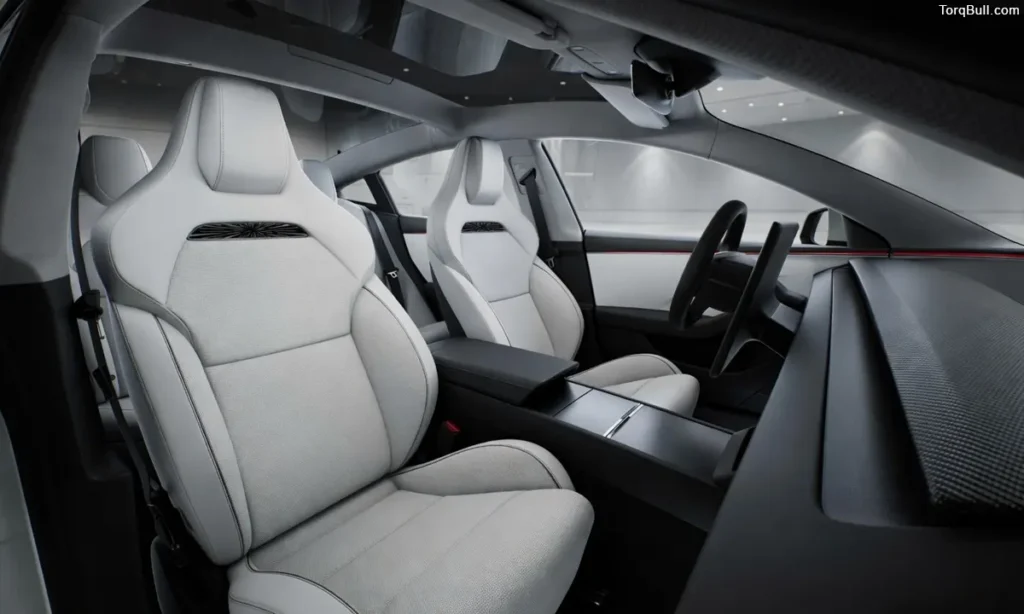
Ride comfort is not only a function of suspension motion — it is the composite experience of suspension compliance, acoustic isolation, seat comfort and vibration management that together determine whether a vehicle feels pleasant to spend hours in. The Highland Model 3 addresses all four dimensions rather than suspension alone, and the cumulative effect produces a cabin experience that earlier Tesla generations could not match.
The acoustic laminated glass on all four side windows reduces road and wind noise at the frequencies most fatiguing to the human ear during long drives. The revised seat design — with contoured foam and improved lateral support — holds occupants more securely without creating pressure points over long distances. The new bushings and subframe mounting reduce the high-frequency vibrations that transmit into the steering wheel and floor, eliminating the minor buzz and tingle that pre-refresh owners in the Tesla Motors Club community frequently reported on motorway surfaces. And the dual-paned front windscreen — present in both generations — continues to provide the acoustic isolation from wind noise that defines Tesla’s approach to high-speed comfort.
The Edmunds one-year fleet review, conducted across the 2024 Long Range AWD by multiple drivers with varied commuting patterns, specifically praises the noise management as exceptional — stating that road, tire and wind noise are “really muted, to a degree that many luxury cars I’ve been in can’t match.” This is perhaps the most powerful summary of the Highland-generation Model 3’s cabin refinement achievement: that it is not simply better than before, but measurably better than most premium vehicles in its price range on the specific metric that matters most for daily comfort.