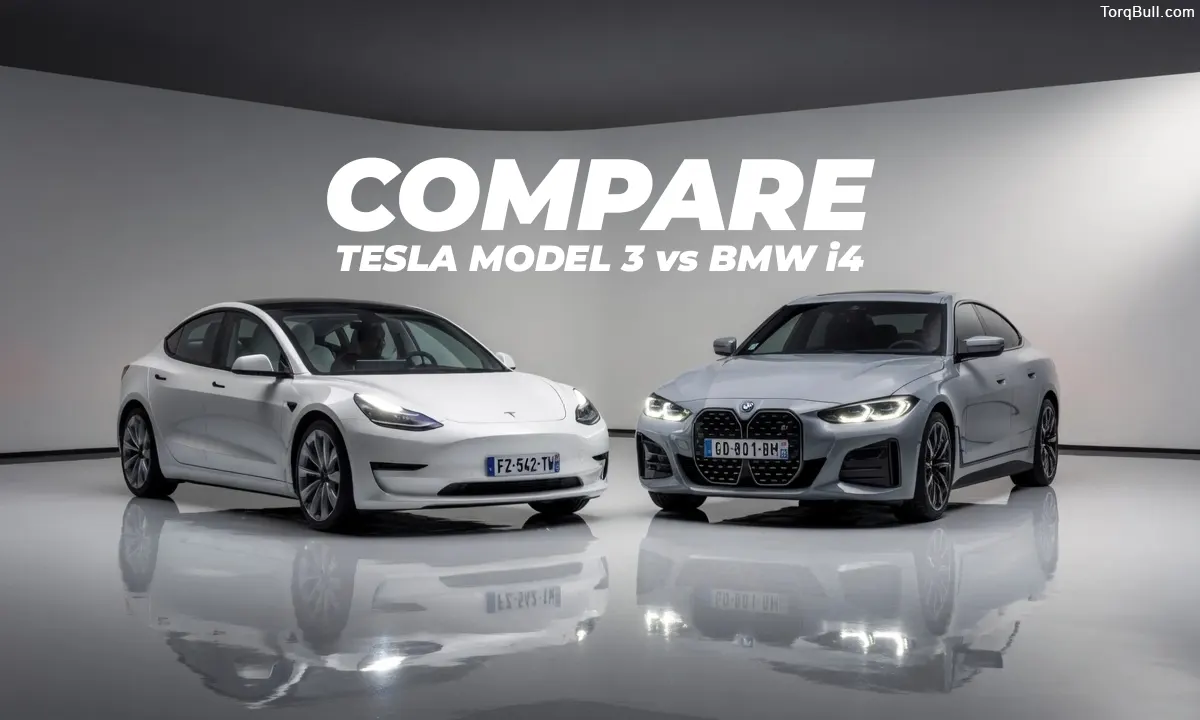
- Tesla Model 3 starts at $38,380 with up to 363 miles range
- 0–60 mph in as quick as 2.9 seconds (Performance)
- Extensive Supercharger network and strong software ecosystem
- BMW i4 eDrive40 starts at $57,900 with ~333 miles range
- Premium interior with leather, curved display and CarPlay
- Tesla focuses on tech and efficiency; BMW on luxury and driving feel
Tesla Model 3 vs BMW i4: The Tesla Model 3 versus BMW i4 comparison is the one that best defines the fundamental split in the premium electric sedan market — not a comparison of similar vehicles at similar prices, but a comparison of two philosophies about what a premium electric sedan should be and what its buyer should value most. The Model 3 is the efficiency, performance and technology argument: more range, faster acceleration, lower price, a charging network that genuinely works and over-the-air software that adds features continuously across the ownership period. The BMW i4 is the luxury, refinement and driving dynamics argument: genuine leather from the base trim, a curved display that blends digital instrumentation with conventional luxury design, physical climate controls, wireless Apple CarPlay and a chassis tuned by the engineers responsible for the benchmark 3 Series — a vehicle that Autoblog’s 2026 Performance trim comparison describes as offering “better or equal quality across key categories for less money” in the Model 3 Performance versus i4 eDrive40 configuration. This guide compares both vehicles completely and delivers the verdict for every buyer profile.
Price: A $20,000 Starting Gap That Only Widens With Options
The most dramatic objective difference between the Tesla Model 3 and BMW i4 is price — and unlike most automotive comparisons where competitors are positioned within a few thousand dollars of each other, these two vehicles occupy meaningfully different price tiers that determine the entire financial context of the ownership decision.
The 2026 Tesla Model 3 Standard RWD starts at $38,380 including destination. The Performance AWD — the high-performance flagship — starts at $54,490. TrueCar places the i4 eDrive40 starting price at $57,900 for 2026, with the M60 high-performance variant exceeding $68,000. The base-to-base price gap of approximately $19,520 is itself significant — but it widens further when federal EV tax credit eligibility is considered.
The Tesla Model 3 qualifies for the $7,500 federal EV tax credit as a domestically assembled vehicle meeting applicable battery sourcing requirements, reducing the effective base price to approximately $30,880 for qualifying buyers. The BMW i4 does not currently qualify for the federal EV tax credit. This creates an effective price gap of approximately $27,020 between a base Model 3 and a base i4 after available incentives — a difference so large that it encompasses an entire year’s income for many buyers.
BMW partially offsets its higher purchase price through included ownership benefits: three years or 36,000 miles of complimentary scheduled maintenance — a benefit the Model 3 does not offer — and four years of roadside assistance. JD Power specifically notes the i4 provides a “significantly more luxurious interior” in exchange for its higher starting price. For buyers who value maintenance inclusion and premium materials from base trim, the i4’s value proposition is real — it is simply starting from a much higher baseline number.
Range and Efficiency: Tesla’s Decisive Advantage
Range is the category where the Tesla Model 3’s engineering priorities most clearly outperform the BMW i4 — and the margin is significant enough to be a meaningful practical differentiator rather than a specification footnote.
The 2026 Tesla Model 3 Premium RWD achieves 363 miles of EPA-rated range — the highest in the Model 3 lineup and among the best in the entire premium electric sedan segment. The base Standard RWD achieves 321 miles. Even the Performance AWD, with its dual-motor setup and performance-oriented tuning, retains 309 miles of EPA range. The Model 3 consistently achieves over 4.0 miles per kilowatt-hour in real-world driving — a figure that reflects both the vehicle’s 0.23 drag coefficient and its efficient thermal management system.
The 2026 BMW i4 eDrive40 achieves a BMW-stated range of 307 to 333 miles from its 83.9 kWh gross battery — approximately 30 to 55 miles less than the comparable Model 3 Long Range. The performance-focused M60 drops further to 232 to 278 miles. The i4 is notably heavier than the Model 3 — approximately 4,680 pounds versus the Model 3’s 4,034 pounds — which contributes meaningfully to its lower efficiency at equivalent speeds. On a direct efficiency comparison, the Model 3 achieves 137 MPGe combined while the i4 eDrive40 achieves approximately 112 MPGe — a 25 MPGe difference representing 18 percent better efficiency in favour of the Model 3.
For daily drivers who rarely approach range limits, the difference between 310 miles and 333 miles is imperceptible. For road-tripping owners who make frequent 200-plus-mile highway drives, a 50-mile range advantage on the Long Range Model 3 versus the i4 eDrive40 translates to meaningfully fewer charging stops over a year’s worth of driving.
Performance: Tesla Wins Straight Lines, BMW Wins the Back Road
Both vehicles deliver genuinely impressive performance from their respective powertrains — but they express that performance through entirely different character and prioritise different aspects of the driving experience.
The Tesla Model 3 Performance reaches 60 mph in 2.9 seconds — one of the fastest 0-60 times available in any production sedan at any price. The AWD models reach 60 mph in 4.2 to 4.6 seconds depending on specification. Tesla’s instant torque delivery produces the characteristic electric surge that defines the Model 3’s acceleration character — smooth, relentless and drama-free until the speed limit becomes an immediate concern. Recharged’s comparison describes the Model 3 Performance’s focus as “maximum straight-line punch” — Tesla has tuned the system specifically for acceleration metrics.
The BMW i4 eDrive40 produces 335 horsepower from its single rear motor, reaching 60 mph in approximately 5.5 seconds. The M60 — the performance flagship at $68,000-plus — produces 593 horsepower with dual motors and reaches 60 mph in approximately 3.7 seconds. Despite the M60’s higher horsepower figure than the Model 3 Performance’s 510 horsepower, the Tesla’s 2.9-second 0-60 is significantly faster than the M60’s 3.7 seconds — demonstrating that horsepower alone does not determine acceleration, and that Tesla’s drivetrain tuning is specifically optimised for this metric.
Where the BMW i4 genuinely surpasses the Model 3 is in dynamic driving character — the feel of the steering, the chassis balance on winding roads and the composed highway ride quality. Autoblog’s 2025 five-differences analysis describes the i4 as emphasising “chassis tuning, steering feel and high-speed stability that will be familiar to anyone who’s driven a recent 3 or 4 Series.” The i4’s suspension tuning, particularly with the optional M Sport Package’s M adaptive suspension and variable sport steering, produces a more engaging back-road experience that the Model 3’s more comfort-oriented suspension calibration does not match. For drivers who use track days and driving events as a measure of their vehicle’s capability, the i4 delivers a more complete dynamic package. For drivers who measure performance by how quickly the car moves between traffic lights, the Model 3 wins decisively.
Read: Tesla Model 3 Hidden Features You Should Know. 12 Hidden Features Will Surprise You
Charging: Tesla Wins on Network, BMW Is Competitive on Speed
Charging access and speed present an interesting split between these vehicles — the i4 is more competitive on hardware charging rate than the range gap would suggest, but remains disadvantaged on charging network reliability and coverage.
The Tesla Model 3 charges at up to 250 kW at V3 Supercharger stations, adding approximately 100 miles of range in 14 minutes. The Supercharger network — approximately 2,000 stations across the United States — provides the most reliable and most uniformly distributed fast charging infrastructure available to any American EV owner. Native NACS integration across all 2026 Model 3 variants means no adapters are required.
The BMW i4 uses CCS charging at up to 200 kW peak DC fast charging, completing a 10 to 80 percent charge in approximately 31 minutes on a compatible 200 kW station. BMW offers a Tesla Supercharger NACS adapter for i4 owners — allowing access to the Supercharger network, though the experience is not as seamlessly integrated as native Tesla use. Healvanna Auto’s 2026 analysis notes that BMW’s Charging app aggregates multiple networks, but reliability and availability of third-party chargers remain less consistent than Tesla’s own stations.
The practical road trip charging experience therefore favours the Model 3 — particularly for owners who travel through regions with limited Electrify America coverage. The i4 owner has access to the full CCS public network plus Supercharger access via adapter, but the routing and reliability of this multi-network approach is more complex and less predictable than the Model 3’s native Supercharger planning.
Interior Quality and Technology: BMW’s Most Compelling Argument
The interior comparison is where the BMW i4 makes its most compelling case — and where the premium pricing finds its most tangible justification.
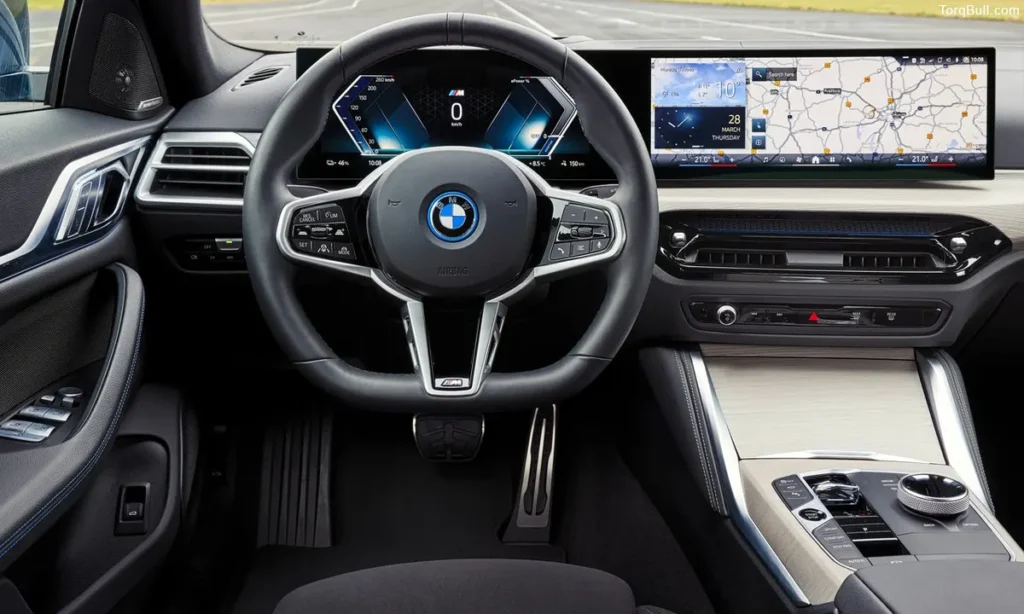
The BMW i4’s cabin features a 14.9-inch curved display combining the instrument cluster and infotainment into a flowing panel, genuine leather upholstery from the base eDrive40 trim, three-zone climate control with physical buttons, an iDrive rotary controller retained for intuitive menu navigation, nine available upholstery colours including premium options like Tacora Red and Canberra Beige, and a standard sound system with an excellent optional Harman Kardon surround sound upgrade. Apple CarPlay and Android Auto are wireless and standard across all i4 trims. Autoblog’s 2025 analysis confirms that “many reviewers note the i4 feels quieter and more refined on the highway” — a direct result of BMW’s decades of NVH refinement experience applied to an electric platform.
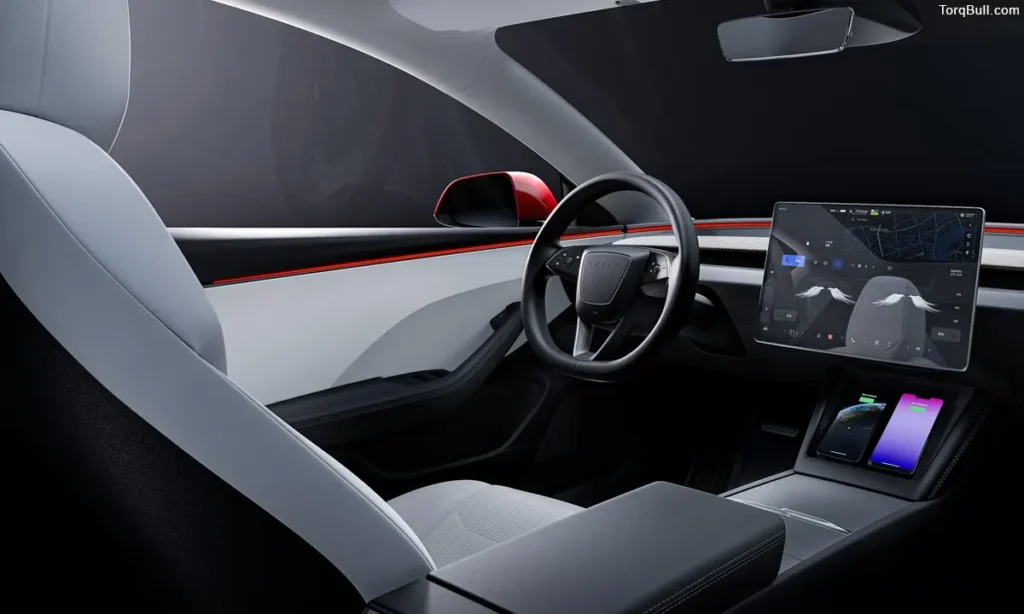
The Tesla Model 3’s interior centres on a 15.4-inch touchscreen that controls virtually all vehicle functions, with two upholstery options — black or white — and a minimalist approach that eliminates most physical controls. The interior material quality on the 2025 to 2026 Highland generation is genuinely improved over prior years, and the 17-speaker audio system outperforms the i4’s standard 10-speaker configuration. But the absence of Apple CarPlay, the touchscreen-only climate and mirror controls and the limited personalisation options create an interior experience that JD Power’s 2026 comparison specifically identifies as less luxurious than the i4 despite being “free of cluttered controls.”
For buyers who spend significant time in their car on long road trips and value interior comfort and craftsmanship as primary quality criteria, the i4 delivers more of what conventional automotive luxury promises. For buyers who prioritise technology sophistication and software currency over traditional luxury materials, the Model 3’s continuous OTA improvement and larger driver assistance feature set is the more compelling offer.
Read: Tesla Model 3 Long-Term Reliability Review. 9 Years of Real-World Data In 2026
Tesla Model 3 vs BMW i4 — Complete Comparison Chart
| Category | Tesla Model 3 (2026) | BMW i4 eDrive40 (2026) | Winner |
| Starting Price | $38,380 | $57,900 | Model 3 |
| After Federal EV Credit | ~$30,880 | ~$57,900 (no credit) | Model 3 |
| EPA Range (base/best) | 321 / 363 miles | 307 / 333 miles | Model 3 |
| Combined MPGe | 137 MPGe | ~112 MPGe | Model 3 |
| 0-60 mph (base) | 5.8 sec (Standard) | ~5.5 sec (eDrive40) | i4 (slight) |
| 0-60 mph (Performance) | 2.9 sec | 3.7 sec (M60) | Model 3 |
| Peak DC Fast Charging | 250 kW | ~200 kW | Model 3 |
| 10–80% Charge Time | ~25–30 min | ~31 min | Model 3 (slight) |
| Charging Network | Supercharger (2,000 US) | CCS + NACS adapter | Model 3 |
| Interior Materials | Improved but minimalist | Premium leather standard | i4 |
| Physical Climate Controls | No | Yes | i4 |
| Apple CarPlay / Android Auto | No | Yes (wireless, standard) | i4 |
| Audio System (standard) | 17 speakers | 10 speakers | Model 3 |
| Autopilot / ADAS | Autopilot + FSD available | Adaptive cruise + ADAS | Model 3 |
| OTA Software Updates | Comprehensive / frequent | Limited | Model 3 |
| Cargo (combined frunk + trunk) | 22.9 cu ft | 45.6 cu ft (no frunk) | i4 |
| Free Maintenance | No | 3 yr / 36,000 mi | i4 |
| JD Power Predicted Reliability | 75/100 | 74/100 | Tie |
| 5-Year Depreciation | ~57% | ~43–48% est. | i4 |
Which Should You Buy? The Buyer Profile Verdict
The Model 3 is the correct choice for buyers who prioritise range confidence, the Supercharger network’s road trip reliability, maximum acceleration at any price point, the lowest total acquisition cost after the federal EV credit and a technology-forward ownership experience anchored by continuous software improvement. At $30,880 effective price after the federal credit, the Model 3 Standard RWD delivers a genuinely extraordinary amount of electric sedan capability per dollar spent. Recharged’s buyer profile analysis is specific: the Model 3 is the better fit for buyers who do frequent long-distance drives where charging reliability is critical and who value built-in route planning that simply works.
The BMW i4 is the correct choice for buyers who value premium interior materials and traditional luxury craftsmanship above range or price, who use Apple CarPlay and Android Auto as essential daily driving tools, who prioritise a dynamic driving experience on winding roads over straight-line acceleration dominance and who appreciate BMW’s three years of complimentary maintenance as a genuine ownership benefit. Autoblog’s 2026 performance trim verdict concludes that the Model 3 Performance is the better buy over the i4 eDrive40 at comparable price points — but acknowledges that the i4 delivers a more refined, more traditionally luxurious experience for buyers whose priorities weight interior quality and brand prestige over efficiency and software sophistication.