- High owner satisfaction and 9.1/10 U.S. News rating
- 90% of KBB owners recommend the Model 3
- Below-average reliability per Consumer Reports
- Misses IIHS Top Safety Pick recognition
- Strong performance and efficiency vs noted drawbacks
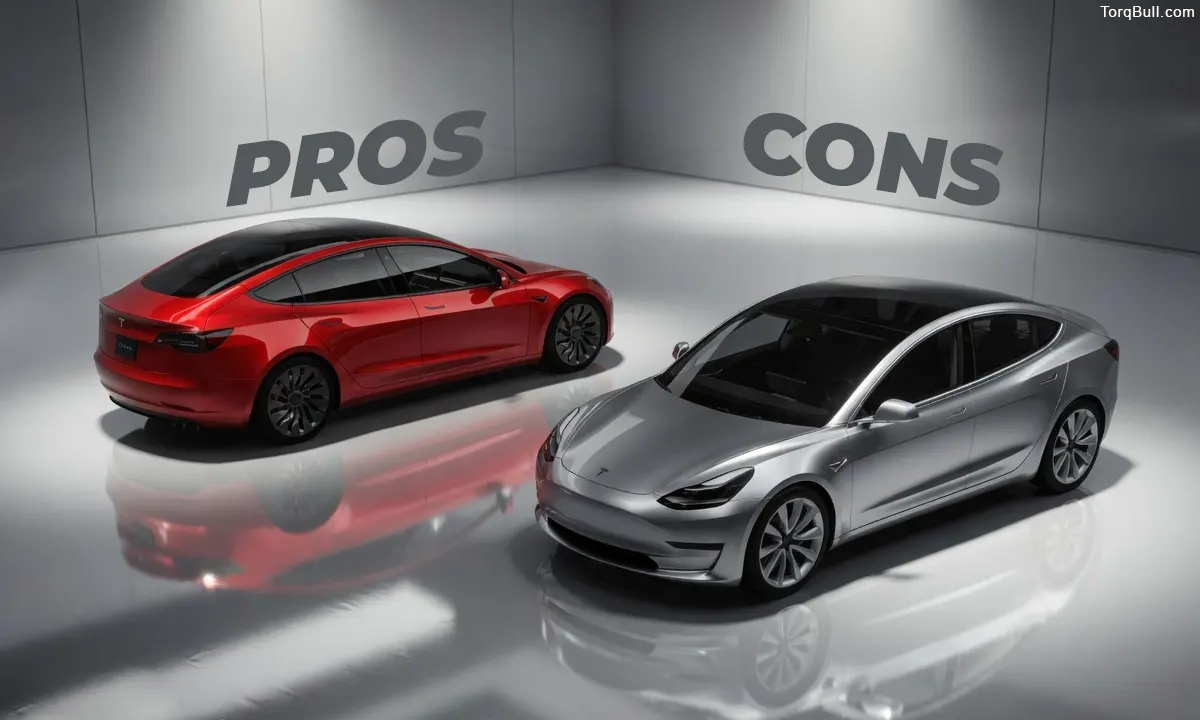
Tesla Model 3 Pros and Cons: The Tesla Model 3 is the most discussed, most debated and most purchased electric vehicle in the United States — and for good reason on all three counts. It redefined what an affordable EV could offer when it launched in 2017, and nine years of continuous development have made the 2026 Highland-generation Model 3 a genuinely compelling vehicle by any objective measure. U.S. News gives it a 9.1 out of 10. KBB’s owner community recommends it at a 90 percent rate. Edmunds calls it one of their favourite EVs. But the Model 3 is also a vehicle with documented weaknesses that are as consistent and as well-evidenced as its strengths — a build quality record that trails European luxury competitors at equivalent prices, an insurance cost premium that offsets a meaningful portion of its fuel savings, a touchscreen-centric control philosophy that genuinely frustrates a significant minority of owners and a depreciation rate that makes new-vehicle purchase less financially advantageous than the fuel cost comparisons alone suggest. This guide assesses every significant pro and con with the same rigour — because a purchase decision informed by both sides of the ledger produces better outcomes than one informed only by enthusiasm.
The Pros: What the Tesla Model 3 Gets Genuinely Right
Pro 1: Range That Eliminates Real-World Range Anxiety
The 2026 Tesla Model 3 Premium RWD achieves 363 miles of EPA-rated range — the highest in the lineup and one of the longest ranges available in any electric sedan at any price below $55,000. Even the base Standard RWD achieves 321 miles. In Edmunds’ real-world highway testing, the Long Range AWD delivered 338 miles — 99 percent of its 341-mile EPA rating — a result that confirms the Model 3 as one of the most accurate-to-EPA-rating vehicles in the EV segment. At 75 mph real-world highway speed, the Long Range variants consistently deliver 280 to 310 miles — sufficient for most American intercity drives without a charging stop. For the majority of buyers who install a home Level 2 charger and plug in nightly, range anxiety as a daily experience simply does not exist.
Pro 2: Performance That Reframes Expectations at Every Trim Level
No other vehicle in the $38,000 to $56,000 price range delivers performance comparable to the Model 3 lineup across all configurations. The base Standard RWD reaches 60 mph in 5.8 seconds — quicker than most mainstream SUVs at twice the price. The Long Range AWD completes the sprint in 4.2 seconds. The Performance AWD, at 2.9 seconds, is among the fastest production sedans available at any price — rivalling dedicated sports cars costing three to five times as much. The instant torque delivery characteristic of electric motors transforms everyday driving in ways that internal combustion cannot replicate, making highway merges, passing manoeuvres and urban acceleration feel effortless and confident.
Pro 3: The Supercharger Network — a Genuine Road Trip Advantage
Tesla’s approximately 2,000-station Supercharger network in the United States is the most reliable, most uniformly distributed and most seamlessly integrated DC fast-charging infrastructure available to any American EV owner. V3 Supercharger stations add approximately 100 miles of range in 14 minutes. The Model 3’s onboard navigation automatically plans Supercharger stops on long-distance routes, preconditions the battery before arrival to ensure maximum charging speed and provides real-time stop-by-stop charging recommendations. For road-tripping owners, the Supercharger network functionally solves the range anxiety problem that plagues EV ownership on competing charging networks.
Pro 4: Software That Continuously Improves the Vehicle
Every Model 3 receives over-the-air software updates that add new features, improve existing capabilities and address software-based issues — all without visiting a service centre or paying for an upgrade. The Spring 2026 update alone introduced the Grok AI voice assistant with “Hey Grok” activation, improved car visualisation, enhanced trip statistics and refined Autopilot behaviour. A 2022 Model 3 in 2026 runs the same software interface as a new 2026 vehicle — a technology continuity that no other automotive manufacturer provides at equivalent scale. This ongoing improvement means the vehicle purchased today is not a static product — it actively evolves across the ownership period.
Pro 5: Low Running Costs That Compound Across Ownership
A Self Financial study examining America’s 50 best-selling vehicles confirmed the Model 3’s annual energy cost at just $638 — 71.68 percent lower than the average fuel cost of $2,246 across the study’s gasoline vehicle set. The elimination of oil changes, spark plug replacement, transmission service, timing chain maintenance and dramatically reduced brake wear through regenerative braking produces annual maintenance costs of approximately $500 to $650 versus $1,000 to $1,400 for a comparable gasoline midsize sedan. Combined, the fuel and maintenance savings accumulate to approximately $7,000 to $8,750 over five years of ownership — a financially meaningful advantage that compounds with each additional year of use.
Pro 6: Autopilot and Driver Assistance as Standard Equipment
Traffic-Aware Cruise Control and Autosteer lane-centering are standard on every Model 3 at no additional cost — features that competing vehicles charge $1,500 to $3,000 to include in option packages. On long highway drives, Autopilot meaningfully reduces driver fatigue while maintaining safety margins and following distance with greater consistency than manual driving in high-traffic conditions. The available Full Self-Driving Supervised adds city street navigation, traffic light recognition and automatic lane changes at $8,000 or $99 per month — an optional upgrade that no competing vehicle at this price point can match in scope.
Pro 7: Long-Term Powertrain Durability
Nine years of Model 3 production data confirms what the electric motor’s mechanical simplicity promises: the powertrain is extraordinarily durable. Tesla’s 2023 Impact Report documents average battery capacity retention of 85 percent at 200,000 miles. High-mileage owners routinely report 150,000 to 200,000 miles with no major motor or battery repairs. Tesla’s design target of 300,000 to 500,000 miles for the drivetrain — equivalent to 20 to 35 years of average American driving — is supported by real-world evidence rather than manufacturer projection alone.
Read: Tesla Model 3 Resale Value After 5 Years. 2026 Data From 15 Million Vehicles
The Cons: Where the Tesla Model 3 Falls Short
Con 1: Insurance Costs That Partially Offset Running Cost Savings
The most significant and most consistently underestimated financial disadvantage of Model 3 ownership is the insurance premium. The national average full-coverage premium for a 2026 Model 3 is approximately $289 to $323 per month — $3,468 to $3,876 annually — approximately $1,000 to $1,700 more per year than comparable coverage for a Honda Accord or Toyota Camry. Over five years, this insurance premium elevation adds $5,000 to $8,500 to the total ownership cost relative to gasoline alternatives — consuming a meaningful portion of the fuel and maintenance savings that form the core of the Model 3’s financial case. The elevated premium reflects the vehicle’s high repair costs, limited certified body shop network and elevated replacement value — structural factors that competitive quote shopping reduces but cannot eliminate entirely.
Con 2: Touchscreen-Only Controls That Divide Owners
The Model 3’s near-total reliance on its 15.4-inch touchscreen for climate control, mirror adjustment, wiper speed, navigation and virtually all other vehicle functions is the most polarising aspect of the ownership experience. U.S. News specifically notes that the touchscreen-based controls are “about as distracting as they get.” Edmunds confirms the touchscreen is a persistent complaint in owner feedback. Drivers who want to adjust the fan speed, change a destination or silence the wiper system without removing their eyes from the road and finding the correct touchscreen menu are presented with a challenge that adaptation ameliorates but does not fully resolve for all drivers. The 2026 model restored physical turn signal stalks in response to owner feedback — a welcome improvement — but the fundamental touchscreen-first design philosophy remains, and buyers who strongly value physical controls should experience the Model 3 as a daily driver before committing.
Con 3: No Apple CarPlay or Android Auto
The Model 3 does not offer Apple CarPlay or Android Auto — a limitation that is increasingly difficult to justify at any price point as virtually every competing EV, from the Hyundai Ioniq 6 to the BMW i4, includes wireless CarPlay and Android Auto as standard features. For buyers whose daily driving relies on iPhone or Android navigation, podcast apps, music services or messaging — features that smartphone integration delivers more reliably and with greater personalisation than Tesla’s native system — the absence of CarPlay is a genuine daily frustration rather than a theoretical limitation. Tesla’s own infotainment is capable and continually updated, but it is not a substitute for the seamless ecosystem integration that smartphone projection provides.
Con 4: Build Quality That Trails European Competitors
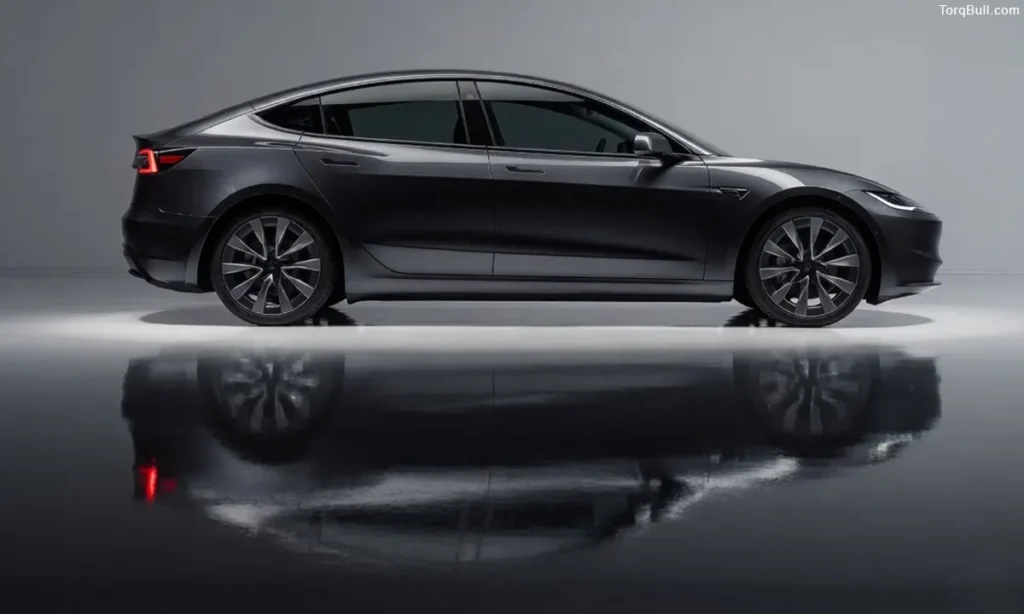
Consumer Reports rates the 2025 Model 3 below average in overall reliability, specifically flagging body hardware including windows, locks and door latches as a concern area. The TÜV 2025 inspection report placed the Model 3 near the bottom of its age class with a higher-than-average defect rate for 2 to 5-year-old vehicles. Panel gaps, thin paint susceptible to chipping, early-build interior rattles and occasional water ingress from improperly seated seals are documented across multiple production years. The Highland refresh improved door alignment and interior material quality meaningfully — but the gap between Model 3 build quality and the BMW i4 or Audi A5 at comparable prices remains real and observable.
Con 5: High Depreciation on New Vehicle Purchases
The Model 3 depreciates approximately 57 percent over five years according to iSeeCars analysis — significantly worse than the Toyota Camry’s 35 percent or the Honda Accord’s 38 percent. On a $38,380 purchase, this implies total five-year depreciation of approximately $21,877 — more than double the Camry’s equivalent depreciation on a lower purchase price. Tesla’s history of new-vehicle price reductions directly reduces used market values for existing owners, compounding the depreciation risk relative to competitors whose pricing history is more stable. This elevated depreciation rate is the primary reason that the total five-year cost of ownership for a new Model 3 often exceeds that of a new Camry despite the fuel and maintenance savings.
Con 6: Service Availability Varies Significantly by Region
Tesla’s direct-to-consumer service model — no franchised dealer network, service concentrated in Tesla-owned centres and mobile service vans — produces dramatically different ownership experiences depending on where the owner lives. In major metropolitan markets with multiple Tesla service locations, most issues are addressed efficiently, often through mobile service requiring no service centre visit. In markets with limited Tesla service infrastructure, owners report extended appointment wait times and reduced mobile service availability. This geographic variability is a meaningful consideration for buyers outside major metropolitan areas.
Read: Is the Tesla Model 3 Worth It in USA in 2026? The Honest Answer
Tesla Model 3 Pros and Cons — Complete Summary Chart
| Category | Pro or Con | Detail |
| Range (363 mi Premium RWD) | Pro | Best-in-class EPA range; 338 mi Edmunds real-world test |
| Performance (2.9 sec 0-60) | Pro | Fastest in class at price; all trims genuinely quick |
| Supercharger network | Pro | 2,000 US stations; native route planning integration |
| OTA software updates | Pro | Monthly improvements; Grok AI in Spring 2026 update |
| Running costs (fuel + maintenance) | Pro | ~$7,000–$8,750 combined 5-year savings vs gas sedan |
| Autopilot standard | Pro | Traffic-Aware Cruise + Autosteer at no extra cost |
| Long-term drivetrain durability | Pro | 85% battery at 200,000 miles; motors rarely fail |
| Insurance cost | Con | $1,000–$1,700/yr more than comparable gas car |
| Touchscreen-only controls | Con | Climate, mirrors, wipers all screen-controlled |
| No Apple CarPlay / Android Auto | Con | Unavailable at any price; competitors include it standard |
| Build quality (panel gaps, paint) | Con | Consumer Reports below average; TÜV inspection concerns |
| Depreciation (new vehicle) | Con | 57% over 5 years vs 35% for Toyota Camry |
| Service geographic variability | Con | Inconsistent experience outside major metro areas |
| Accelerated tyre wear | Con | Heavier and higher torque than equivalent gas sedans |
Who the Model 3’s Pros Outweigh the Cons For
The pros outweigh the cons most decisively for buyers who home-charge consistently, drive 12,000 or more miles annually, plan to keep the vehicle for five or more years and live within reasonable reach of Tesla service. At these parameters, the range confidence, performance, Supercharger network and running cost savings collectively produce an ownership experience that the cons — real as they are — do not meaningfully diminish. The financial case is strongest for used Model 3 buyers in the $24,000 to $30,000 range, where the depreciation disadvantage has already been absorbed by the first owner and the running cost advantages remain fully intact.
The cons outweigh the pros most clearly for buyers who cannot charge at home, who plan short ownership periods where the depreciation penalty dominates the calculation, who rely on Apple CarPlay or Android Auto as essential daily tools, who are in high-insurance markets where the premium differential is most pronounced and who prioritise traditional luxury material quality over technology sophistication. For these buyers, the Hyundai Ioniq 6, Toyota Camry Hybrid or BMW i4 may deliver a better total ownership experience at equivalent or lower total cost.